Showing posts with label Airworthy. Show all posts

Tuesday, 25 November 2014

Happy Birthday DH 98 Mosquito !

Seventy-four years ago today, the de Havilland DH.98 Mosquito took flight for the first time.

One of the most useful Allied aircraft of World War II, the Mosquito performed as a bomber, fighter, anti-shipping and photo-reconnaissance platform.  The key to the success of the “Wooden Wonder” was its light wood construction and the power of its twin Merlin engines, which gave it the speed to out-fly almost every other aircraft type of the war.  Nicknamed the “Mossie” by its crews, the Mosquito could fly virtually unchallenged and deliver devastatingly precise attacks with bombing radar.
 
Photo by Luigino Caliaro


Production of all Mosquitoes totaled 7,781 and the DH.98 served with over a dozen nations.  A Mosquito became the first twin-engine aircraft to land on a ship on March 25, 1944, aboard the Royal Navy aircraft carrier HMS Indefatigable.

dh98_proms_2013_001

Here is a photo of the DH.98 Mosquito from the Military Aviation Museum in Virginia Beach, Virginia taking-off during the 2013 Flying PROMS airshow.

This Mosquito was built in Canada in 1945 but never saw combat during the war.  The Military Aviation Museum acquired the aircraft in 2004 and it was shipped to New Zealand to undergo an eight-year restoration.  The restored aircraft made its first flight  (clicky) here in New Zealand in September 2012 and arrived back at the Military Aviation Museum in March 2013.  It is painted as EG-Y to replicate the No. 487 (NZ) Squadron of the Royal New Zealand Air Force as a tribute to those responsible for the restoration.

Wiki: The de Havilland DH.98 Mosquito was a British multi-role combat aircraft with a two-man crew that served during and after the Second World War. It was one of few operational front-line aircraft of the era constructed almost entirely of wood and was nicknamed "The Wooden Wonder".

 The Mosquito was also known affectionately as the "Mossie" to its crews. Originally conceived as an unarmed fast bomber, the Mosquito was adapted to roles including low to medium-altitude daytime tactical bomber, high-altitude night bomber, pathfinder, day or night fighter, fighter-bomber, intruder, maritime strike aircraft, and fast photo-reconnaissance aircraft. It was also used by the British Overseas Airways Corporation (BOAC) as a fast transport to carry small high-value cargoes to, and from, neutral countries, through enemy-controlled airspace.

When the Mosquito began production in 1941, it was one of the fastest operational aircraft in the world. Entering widespread service in 1942, the Mosquito was a high-speed, high-altitude photo-reconnaissance aircraft, continuing in this role throughout the war. From mid-1942 to mid-1943 Mosquito bombers flew high-speed, medium or low-altitude missions against factories, railways and other pinpoint targets in Germany and German-occupied Europe. From late 1943, Mosquito bombers were formed into the Light Night Strike Force and used as pathfinders for RAF Bomber Command's heavy-bomber raids. They were also used as "nuisance" bombers, often dropping Blockbuster bombs - 4,000 lb (1,812 kg) "cookies" - in high-altitude, high-speed raids that German night fighters were almost powerless to intercept.

As a night fighter, from mid-1942, the Mosquito intercepted Luftwaffe raids on the United Kingdom, notably defeating Operation Steinbock in 1944. Starting in July 1942, Mosquito night-fighter units raided Luftwaffe airfields. As part of 100 Group, it was a night fighter and intruder supporting RAF Bomber Command's heavy bombers and reduced bomber losses during 1944 and 1945.

 As a fighter-bomber in the Second Tactical Air Force, the Mosquito took part in "special raids", such as the attack on Amiens Prison in early 1944, and in precision attacks against Gestapo or German intelligence and security forces. Second Tactical Air Force Mosquitos supported the British Army during the 1944 Normandy Campaign. From 1943 Mosquitos with RAF Coastal Command strike squadrons attacked Kriegsmarine U-boats (particularly in the 1943 Bay of Biscay, where significant numbers were sunk or damaged) and intercepting transport ship concentrations.

The Mosquito flew with the Royal Air Force (RAF) and other air forces in the European, Mediterranean and Italian theatres. The Mosquito was also operated by the RAF in the South East Asian theatre, and by the Royal Australian Air Force (RAAF) based in the Halmaheras and Borneo during the Pacific War.

Tuesday, 10 June 2014

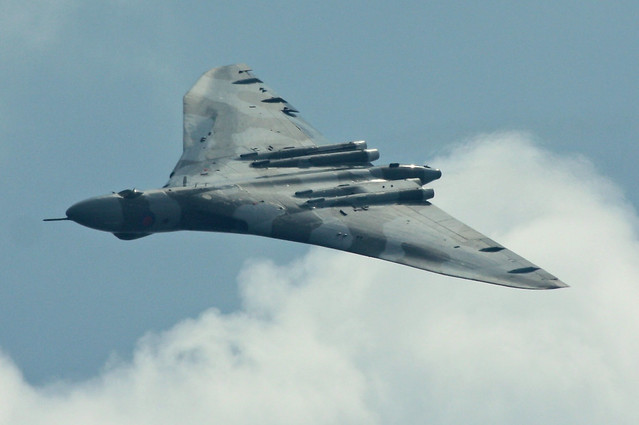
Avro Vulcan XH 558

Almost Airworthy Vulcan XH 558 to fly again?


Vulcan XH558 landing after her aerial display at the 2013 Waddington Air Show with static display XM607 in background. Image Credit: Alan Wilson Creative commons


Avro Vulcan XH558 (civil aircraft registration G-VLCN) The Spirit Of Great Britain was the only airworthy example of the 134 Avro Vulcan V bombers that were operated by the Royal Air Force from 1953 until 1984. Vulcan XH558 served with the RAF between 1960 and 1985 in the bomber, maritime reconnaissance and air-to-air refuelling roles. The RAF operated XH558 as a display aircraft from 1986 until 1992, when budget cuts forced its retirement. It has been grounded since 2013 with a fuel leak and wing problems.

XH558 was retired from RAF service in 1984 but continued flying as a display aircraft until 1992, when the government pulled the plug on funding.  Unlikely to ever fly again, more than a decade later a mammoth restoration effort began to restore it to flying condition.  The Vulcan to the Sky Trust, the charity that owns XH558, raised over £6 million to overhaul the aircraft and secure a license to fly – seemingly achieving the impossible! 

 In 2007, the mighty Vulcan flew for the first time in 15 years, testament to the incredible work of the Trust and the generous support of fans across the world.  And thanks to a mystery donation the Vulcan has just been saved from likely permanent grounding, but funding is still a grave concern.  The Vulcan celebrates its 50th birthday this year.  


XA309 in the White Livery of the 1960s

It is operated by the Vulcan to the Sky Trust as a display aircraft, funded entirely by charitable donations and the UK Lottery's Heritage Fund. It is registered with the United Kingdom Civil Aviation Authority as G-VLCN but has an exemption to fly in Royal Air Force markings as XH558.

XH558, was the twelfth Vulcan B2 built, first flew in 1960 and was delivered to No. 230 Operational Conversion Unit RAF at RAF Waddington on 1 July 1960. Almost immediately the aircraft moved with 230 OCU to RAF Finningley where the aircraft spent some eight years before returning to Lincolnshire in 1968. Most of its operational service was with the units of the Waddington Wing including No. 50 Squadron RAF. The aircraft was one of nine converted to a SR2 Maritime Radar Reconnaissance configuration in 1973 and flew with 27 Sqn. 


XH558

For the maritime reconnaissance role the terrain following radar (TFR) was removed and replaced by LORAN C equipment. XH558 was subsequently one of six Vulcans converted to the air-to-air refuelling variant K2 in 1982. The air-to-air refuelling variant was assessed on 1 May 1982. Go ahead for modification was given three days later and the first aircraft (XH561) made its maiden flight on 18 Jun 1982 and flew to Waddington five days later. XH558 was returned to standard B2 configuration in 1985 and was the last Vulcan in service, largely due to the fact that it had seen little service as a low-level bomber and had spent considerable time grounded while undergoing its various modifications. From 1986 to 1992, XH558 was the RAF's display aircraft, until budget cuts forced it to be grounded again.

After service with the Royal Air Force, the aircraft and most of the RAF spare parts for the Vulcan were sold to C.Walton Limited and delivered by air to Bruntingthorpe Aerodrome on 23 March 1993. The aircraft was kept in a serviceable condition and would undertake fast taxi runs along Bruntingthorpe's main runway.


XH558  from a Lancaster's rear turret - what a shot ! 

The engineering staff of the Vulcan Operating Company (the engineering arm of Vulcan to the Sky Trust, owners of XH558) worked to return Vulcan XH558 to flight, with the first test flight taking place 18 October 2007. They were supported by the "Vulcan to the Sky" club, a supporters and fundraising organisation. Though the website carried an announcement on 1 August 2006 that the project was in danger of being abandoned due to lack of finance,  the target of raising the remaining £1.2m was achieved on 31 August 2006, thanks to a high-profile publicity campaign orchestrated by the supporters club, Vulcan to the Sky Club (formerly Vulcan 558 Club). Time had almost run out for XH558 when Sir Jack Hayward, a British philanthropist, donated £500,000, which topped off the £860,000 already raised by Vulcan to the Sky Club and Friends. Although the aircraft restoration was nearly complete, the aircraft was not ready for the flypast down the Mall in London for the 25th Anniversary of the Falklands conflict on 17 June 2007 or the RAF Waddington Airshow and the Royal International Air Tattoo (RIAT).

It was intended that the Vulcan would fly during at least one UK airshow during the 2007 season. but due to delays in returning the aircraft to flight, mainly down to delays in the return of refurbished flight-critical components, the aircraft was not ready for the display season.

On 16 August 2007, the aircraft started engine testing on the airfield at Bruntingthorpe. On the next day, XH558's No.3 Rolls-Royce Olympus 202 jet engine was run for the first time in over 20 years. This is a different engine from that used by XH558 during its final season with the RAF's Vulcan Display Flight in 1992, with all four of the Vulcan's original Olympus 202 engines having been replaced by zero-hour units which had been stored since 1982. The VTS Team also has another four fully inhibited engines in stock. The removed engines were either scrapped, sectioned for display or passed on to VRT's XL426 at Southend. Another milestone in the restoration project was achieved on 22 August 2007, when all four of XH558's Olympus engines were run at nearly full power settings, for short intervals. The first post-restoration flight, which lasted 34 minutes, took place on 18 October 2007.


On 14 April 2008, the Vulcan flew from Bruntingthorpe to RAF Cottesmore to have a Compass swing and test flights. Whilst in mid air the plane called Mayday after believing the Auxiliary power unit (APU) was on fire. It landed safely at Cottesmore and the cause was later discovered to be an electrical fault.

On 16 April, a further two-hour test flight was planned to perform "straight line testing" of avionics. The flight was scheduled to go between Cambridge and Marham, but this was abandoned when one of XH558's undercarriage doors failed to close due to an electrical micro-switch malfunction and the aircraft made a safe return to Bruntingthorpe Airfield.


On 9 June 2008, XH558 flew its final test flight and was granted on 3 July, by the CAA, its Permit to Fly at 1605. At 1705, it launched for RAF Waddington where it flew its airshow routine, in front of Civil Aviation Authority of the United Kingdom examiners who then issued its DA (Display Authorisation) for the RAF Waddington airshow in the first week of July.

On 29 March 2011, XH558 landed at its new home Robin Hood Airport Doncaster Sheffield. This location is the former RAF Finningley airbase where XH558 was previously based for 8 years during the 1960s. The aircraft will be stored and maintained in the hangar that previously provided the same maintenance workshop nearly 50 years earlier.

The longer-term aim is to make the authorised modifications that will allow fatigue life to match expected engine life, with both expiring at about the same time in the period 2013 to 2015, depending on Fatigue Index usage and engine cycle usage.

The "Vulcan Howl"

A serendipitous arrangement in air intakes causes some Vulcan airframes to emit a distinctive "howl" when the engines are at approximately 90% power. This noise is produced by XH558, and is a popular feature of its flypasts at public airshows.
As the aircraft operates under visual flight rules (VFR) it cannot fly through cloud to higher altitudes where turbulence is lower, as this would require instrument flight rules (IFR) certification. Flying VFR in lower, often turbulent, air adds to airframe fatigue and this increases fatigue-index (FI) consumption. In 2010 the aircraft was therefore limited to between 30 and 40 hours flight-time, to help reduce FI usage and preserve the airframe. As a result, the number of air show appearances were fewer than in 2009. Some two-day fly-in shows were limited to just one appearance, with the first day being given preference to allow the second day to act as a reserve in case of technical or weather difficulties

2012

After extensive servicing over the 2011-2012 winter, XH558 had its CAA certificate renewed in April 2012, in time to perform a flypast at the dedication of the Falklands Memorial at the National Memorial Arboretum on 21 May.
During take off from Robin Hood airport for a practice flight on 28 May, both port engines failed. The failure was attributed to ingestion of silica gel desiccant bags. Damage sustained was limited to the engines and no structural damage was found. Both port engines were deemed beyond repair and replaced with engines in the trust's stocks. The aircraft was returned to flight for the 2012 Farnborough International Airshow, and has subsequently displayed throughout the 2012 season.


Inverted ?

2013
On 12 October 2012, it was announced by Vulcan To The Sky that 2013 was likely to be the last flying season for the Vulcan, six years after her first post restoration flight. 

Reasons cited for the decision to end flight are due to the Vulcan requiring complex wing leading edge skin reinforcement, and a lack of spare engines after the incident in May 2012 when two engines were damaged beyond repair and the last working spares were used to replace them. However, on 25 January 2013, it was announced that wing modification investigations have begun after having contracted Cranfield Aerospace, who would extend her flying period beyond 2013.

 It was featured at the RNAS Yeovilton's Air Day in July 2013. Later on in the year, it was confirmed that the wing modification was viable and a fundraising campaign referred to as Operation 2015 was launched. With sufficient funding raised, the modifaction was enacted, and in March 2014 the necessary modification was completed, extending XH558's flying hours.


Wednesday, 4 June 2014

Restored Bristol Blenheim

Restored Bristol Blenheim sees the light


 Global Aviation Resource reports that May 30th the  Imperial War Museum Duxford the Aircraft Restoration Company’s Bristol Blenheim appeared in public as a complete aircraft for the first time since its long-term rebuild began in the summer of 2003.


WW 2 Blenheim

ARCo recovered their first Blenheim from Canada in the 1970s (RCAF serial 10038). The airframe was originally license-built by Fairchild Canada as a Bolingbroke Mk.IVT; essentially a Blenheim Mk.IV with some modifications and North American hardware/instrumentation. ARCo worked on the aircraft for twelve years, restoring her as a Blenheim Mk.IV (registered as G-MKIV). She made her first flight in May 1987, but was involved in a touch-and-go landing accident at Denholm Airfield just a month after and written off, miraculously without loss of life. Undeterred, her restoration crew determined to get another Blenheim back in the air. They obtained a further Canadian-built Bolingbroke IV (RCAF 10201), and managed to get her flying again in just five years as G-BPIV; their previous experience helping greatly to speed up the rebuild progress. She flew again in June 1993; the world’s only flying Blenheim was a huge hit on the air show circuit!


When she was airworthy


Unfortunately, the Blenheim crash-landed again in August 2003; this time at Duxford. While the aircraft suffered considerable damage, she wasn’t broken beyond repair. The Blenheim’s crew didn’t give up on her and formed a trust to ensure her continued operation in the UK.  They contracted ARCo to provide two full-time engineers to support the restoration project undertaken by Blenheim Duxford Ltd. (and supported by The Blenheim Society).


The Blenheim has undergone a thorough rebuild inside Duxford’s Hangar 3, and more recently in ARCo’s workshop. Interestingly, the team has decided to rebuild the aircraft to Mk.I standard. The bulk of the aircraft is nearly identical to a Mk.IV, except for the forward fuselage which is radically different. The Mk.I is essentially extinct (as are British-built Blenheim IVs, with no complete examples known to exist), but a few forward fuselages survive. One of these ended up at Duxford a few decades ago.

Ralph Nelson, a Bristol employee, had converted it into a peculiar automobile during 1946, using the chassis and power train from an Austin 7

The Mk.I fuselage comes from Blenheim L6739, a Battle of Britain night-fighter veteran. The Blenheim Society obtained the “car” intending to rebuild it into a fully operational nose section for a potential swap with the Mk.IV nose. The team had already begun this process before the 2003 accident, so it seemed logical to blend what they had already completed into G-BPIV’s restoration once that began. They rolled out the freshly restored “Blenheim Mk.I” in night fighter camouflage just a few days ago, and will eventually mark her as L6739. ARCo ran one of the aircraft’s Bristol Mercury engines on May 23rd, and expect to run the other very soon. If all goes well, she will be flying again very soon and delighting air show audiences again across the UK

Blenheim Survivors


BL-200 (bearing the Hakaristi) at the Aviation Museum of Central Finland.


There are currently no Blenheim or Bolingbroke aircraft that are airworthy. One airworthy Blenheim had been rebuilt from a scrapped Bolingbroke over a 12-year period, only to crash at an airshow at Denham within a month of completion in 1987.


Denham Bolingbroke Crash


A replacement Bolingbroke Mk IVT was rebuilt to flying status in just five years and painted to represent a Blenheim Mk IV in RAF wartime service. It began appearing at air shows and exhibitions in the UK, flying since May 1993 and was used in the 1995 film version of Shakespeare's Richard III. This aircraft crashed on landing at Duxford on 19 August 2003; the crash was feared to have made it a write-off,  but it is presently undergoing an extensive repair and conversion to the Mark I "Short nose" version by The Aircraft Restoration Company (ARC or ARCo) at Duxford, most of the work being done by volunteers.


The Duxford Crash

Funds are raised through donations and also by The Blenheim Society who run a Grand Flying Draw among many other activities. The aircraft is currently in the Aircraft Restoration Company hangar at Duxford and is the property of Blenheim (Duxford) Ltd.

In Canada, a number of other Bolingbrokes survived the war but were summarily consigned to the scrap heap. Postwar, enterprising farmers often bought surplus aircraft such as these for the scrap metal content, tyres for farm implements, and even for the fuel remaining in the tanks. Some surviving examples in Canada of the Bolingbroke can be traced back to this period. The Canadian Warplane Heritage Museum in Hamilton, Ontario is rebuilding a Bolingbroke to airworthy status. The Commonwealth Air Training Plan Museum in Brandon, Manitoba has restored the exterior of one Bolingbroke, painting it in the Air Training Plan yellow color. This particular aircraft is on display at a location on the Trans-Canada Highway in Brandon. A restored Bolingbroke is on static display at the British Columbia Aviation Museum in Victoria, British Columbia. The Canadian Museum of Flight at Langley Airport, Langley, British Columbia has on display the restored nose and cockpit section of a Bolingbroke, and holds the rest of an entire airframe in storage pending future restoration and display.

In Finland, the sole surviving original Blenheim in the world, a Mk IV registered as BL-200 of the Finnish Air Force, has been completely restored and is now on display at the Aviation Museum of Central Finland at Tikkakoski.


Finnish survivor- the only intact and complete original Blenheim

In the summer of 1996, a Bristol Blenheim Mk IVF was recovered from the sea, a few km off Rethymnon, Crete. The aircraft belonged to No. 203 Squadron RAF and was downed by friendly fire on 28 April 1941. The Blenheim was restored and moved to the Hellenic Air Force Museum. In Arizona, the Pima Air Museum has a Bristol Blenheim Mk IV on static display

Tuesday, 13 May 2014

Dakotas to Remember D-Day: The C-47 Dakota Part 1

D-Day Remembrance: C-47 Dakotas to drop Parachutists once more


On 6 June 2014 it is exactly 70 years ago that the largest invasion in history took place. 

On D-Day the beach landings saw almost 7 000 ships transport over 160 000 young men to the beaches of Normandy in France, to liberate Europe. This invasion was preceded by the landing of 13 000 paratroopers behind the enemy lines. Most of them jumped from the famous Douglas C-47 Dakota; the workhorse of the Allied troops.


The 70th anniversary of the D-day Invasion in June 2014 sees a “Dakota Fest” to bring as many of these aircraft that are still airworthy to Normandy again, and allow sky diving enthusiasts with the WW 2 style round parachutes to drop down to Normandy again !

For the first time since 1944 the skies over Normandy will be filled with Dakotas to drop paratroopers. Throughout Europe about 15 of these aircraft are still flying, and several will be joining from the US and Canada.


The only Airworthy Dakota in New Zealand

This has galvanised me to do a series of posts on the grand old Lady of the skies: 
The DC3/AC47 Skytrain or Dakota...watch this blog!

Tuesday, 29 April 2014

Junkers JU 87 Stuka Survivors and replicas (Stuka Part 1)

Airworthy Junkers JU 87 Stuka - 1940s Terror of the Skies

Survivors and Replicas

Steve Scheckter recently placed a photo of a replica/model Ju87 on Facebook, apparently flying over European  countryside. I guessed it was a Photoshop picture, as I'm reasonably sure there are no airworthy Ju 87 in the world. Well, then again, that was also said of the Mosquito, so I did a bit of research on the history and current facts, and came up with this:

History (Wiki) :

The Junkers Ju 87 or Stuka (from Sturzkampfflugzeug, "dive bomber") was a two-man (pilot and rear gunner) German dive bomber and ground-attack aircraft. Designed by Hermann Pohlmann, the Stuka first flew in 1935 and made its combat debut in 1936 as part of the Luftwaffe's Condor Legion during the Spanish Civil War.


The aircraft was easily recognisable by its inverted gull wings and fixed spatted undercarriage, upon the leading edges of its faired main gear legs were mounted the Jericho-Trompete ("Jericho Trumpet") wailing sirens, becoming the propaganda symbol of German air power and the blitzkrieg victories of 1939–1942. The Stuka's design included several innovative features, including automatic pull-up dive brakes under both wings to ensure that the aircraft recovered from its attack dive even if the pilot blacked out from the high acceleration.

Although sturdy, accurate, and very effective against ground targets, the Ju 87, like many other dive bombers of the war, was vulnerable to modern fighter aircraft. Its flaws became apparent during the Battle of Britain; poor manoeuvrability and a lack of both speed and defensive armament meant that the Stuka required heavy fighter escort to operate effectively.

The Stuka operated with further success after the Battle of Britain, and its potency as a precision ground-attack aircraft became valuable to German forces in the Balkans Campaign, the African and Mediterranean theaters and the early stages of the Eastern Front campaigns where Soviet fighter resistance was disorganised and in short supply.

Once the Luftwaffe lost air superiority on all fronts, the Ju 87 once again became an easy target for enemy fighter aircraft. In spite of this, because there was no better replacement, the type continued to be produced until 1944. By the end of the conflict, the Stuka had been largely replaced by ground-attack versions of the Focke-Wulf Fw 190, but was still in use until the last days of the war. An estimated 6,500 Ju 87s of all versions were built between 1936 and August 1944.

Some notable airmen flew the Ju 87. Oberst Hans-Ulrich Rudel was the most successful Stuka ace and the most highly decorated German serviceman of the Second World War. The vast majority of German ground attack aces flew this aircraft at some point in their careers.

See a separate post on the history: Ju 87 Stuka History Part 2

Survivors
Two intact Ju 87s survive:

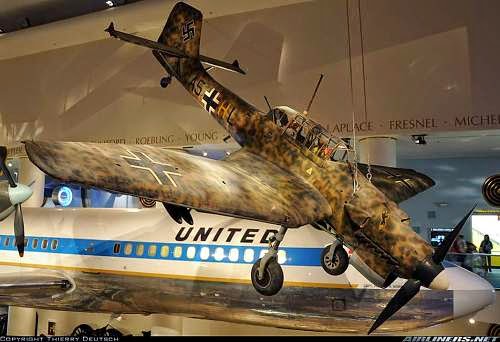
Ju 87 R-2/Trop. Werk Nr. 5954


This aircraft is displayed in the Chicago Museum of Science and Industry. It was abandoned in North Africa and found by British forces in 1941. The Ju 87 was donated by the British government and sent to the USA during the war. It was fully restored in 1974 by the EAA of Wisconsin.

Ju 87 G-2, Werk Nr. 494083


A later, ground-attack variant, this is displayed at the Royal Air Force Museum in London; it was captured by British troops in Germany in 1945. It is thought to have been built in 1943–1944 as a D-5 before being rebuilt as a G-2 variant, possibly by fitting G-2 outer wings to a D-5 air frame. After the war, it was one of 12 captured German aircraft selected by the British for museum preservation.

 In 1967, permission was given to use the aircraft in the film Battle of Britain and it was repainted and modified to resemble a 1940 variant of the Ju 87. The engine was found to be in excellent condition and there was little difficulty in starting it, but returning the aircraft to airworthiness was considered too costly (and risky)  for the filmmakers, and ultimately, models were used in the film to represent Stukas. (see below)

 In 1998, the film modifications were removed, and the aircraft returned to the original G-2 configuration.

Junkers Ju 87 R-2 Werk Nr. 0875709 is owned by Paul Allen's Flying Heritage Collection (FHC) and is believed to be under a long-term restoration to fly. It served bearing the Stammkennzeichen of LI+KU with 1./St.G.5, and was recovered to the United Kingdom in 1998 before being sold to the FHC. It is likely to be the best candidate for an airworthy restoration.

Other aircraft survive as wreckage, recovered from crash sites.

1. The Deutsches Technikmuseum in Berlin has the wreckage of two complete aircraft that were recovered from separate crash sites near Murmansk in 1990 and 1994.

These wrecks were purchased from New Zealand collector Tim Wallis, who originally planned for the remains to be restored to airworthy, in 1996.

The Sinsheim Auto & Technik Museum displays the remains of an aircraft that crashed near Saint-Tropez in 1944 and was raised from the seabed in 1989.


2. In October 2006, a Ju 87 D-3/Trop. was recovered underwater, near Rhodes, Greece:

Ju-87 STUKA salvaged in Greece-15.jpg

Markings still visible after almost 70 years under water
S7+GM

Ju-87 STUKA salvaged in Greece-11.jpg

Ju-87 STUKA salvaged in Greece-2.jpg


More on the history of this aircraft: 

According to a combination of available historical data, it appears that the aircraft is most probably S7+GM (100375), crewed by Lt. Rolf Metzger & Uffz. Hans Sopnemann - both MIA), which was shot down on 9 October 1943.

The Hellenic Air Force web-site tells us this about this aircraft:
"On that very day the II/St.G. 3 lost a total of nine Ju 87D-3/Trop when they were intercepted during their mission against Royal Navy and Hellenic Navy ships in the Aegean. Of these nine, seven crashed into the sea and two made emergency landings on Rodos. A week before, German troops had landed on the island of Kos, which fell the next day. On 9 October 1943, HMS cruiser "Carlisle" and other destroyers, returning from a sweep west of Kos, were dive-bombed SW of Rodos Island by a formation of Ju-87 Stukas. "Carlisle" was seriously damaged and HMS destroyer "Panther" was sunk. Most of her crew were saved by the RHN destroyer "Miaoulis", which has also claimed firing against the Ju-87 formation and probably hit a couple of them."

3.  Junkers Ju 87 B-2 9801 (serial number: 0406) is under reconstruction at Yugoslav Aeronautical Museum.

5. The fuseage of a Junkers Ju 88 was raised 6 miles off the coast of the German Island of RĂ¼gen in June 2012, the team of German Army researchers having thought it to be a Stuka. The two Junkers planes shared several parts, including the engines, and from the way it sat in the seabed it reportedly appeared to have been a Ju 87.

British Flying Replicas

 During the filming of 'The Battle of Britain' in 1968, serious thought was given to using the Hendon Stuka for the Ventnor radar bombing scenes. At the time the Stuka was part of the Air Historic Branch's collection of German aircraft, and it was decided by them that the Ju 87 was too valuble to risk (It was unique at that point).

The cost of getting the aircraft airworthy would have been prohibitive, but they did get the engine running, and this was recorded for use on the films soundtrack. Next they bought 4 Percival Procters for conversion to 'lookalikes'. The work was carried out by Viv Bellamy and entailed a major redesign of the cockpit glazing, new rectangular tail plane, rear fuselage cut down and new centre section built to pass for the distinctive Stuka cranked wing. 


The conversion was pretty convincing but, when flight tested by Bellamy, they did not fly well and were not used for filming. Their places were taken by large-scale radio controlled models which bombed the Ventnor film set constructed at The Mound near Dover.

New Zealand Static replica:

The full-size replica Stuka built by Lester Hope and his team of dedicated volunteers for Classic Fighters, was moved to its new location outside the Omaka Aviation Heritage Centrey. Here it joins its contemporary adversary, the replica Hawker Hurricane. 


Frankfurt Airport Static Replica:

Image

Ukranian scaled down  flying replica, one of many in the world.


Monday, 15 July 2013

RNZAF De Havilland Vampires

RNZAF De Havilland Vampires

I went to the Soutward Car Museum in Paraparaumu, New Zealand with some visitors on Saturday, and found myself delighted to see a Vampire Aircraft suspended from the ceiling!


The aircraft is a Vampire (DH 100) FB.5 (NZ5770)


The aircraft is NZ5570, late of the RNZAF and Former Royal Air Force WA444


Previously WA444 delivered to RAF 20 July 1951 and served with Nos. 145 and 234 Squadrons and No. 2 Tactical Air Force Communications Support Unit. SOC with RAF on 17 May 1956.

 Shipped to New Zealand on 'Hertford". BOC 25 June 1956. Took part in Exercise Silver Bullet the farewell tour of New Zealand to mark the withdrawal of the Vampire during late 1972. 


Flown to Woodbourne for storage 15 December 1972 and sold by GSB tender number DO1523 16 March 1973. To Swedish Museum but sale fell through and aircraft was retendered.

Sold to Southward Motor Museum, Paraparaumu. Presently on display at Southward Motor Museum, Paraparaumu.


Also on display is this Bleriot replica, used in he 1960's movie 
'Those Magnificent Men in their Flying Machines'.


Other Kiwi Vampires:
(Copyrights as indicate, and happy to credit if notified)
Vampire NZ5765  
Wanaka 
2nd April 2010
Photo by George Canciani

Vampire NZ5772
Ohakea 1980s 
Photo via Winstonwolfe Wikipedia

DH.115 Vampire 
NZ5710
RNZAF Photo

Vampire NZ5755 
Lilydale 
21st November 2004
Photo by George Canciani


Amelia Earhart's sad demise

Dozens heard Amelia Earhart's final, chilling pleas for help, researchers say Distilled from 2 posts in the  Washington Post a...