Showing posts with label Messerschmitt. Show all posts

Thursday, 28 May 2015

Me 262B-1 Twin Seater Night Fighter Survivor- Johannesburg, South Africa

Red 8: The only Surviving Me 262B-1 Night fighter (Nachtjaeger)


Surviving samples of the world's first operational jet fighter are rare

1500+ Messerschmitt Me 262s were produced, but only eight aircraft survive today.
(Ten if you count the two post-war Avia S-92s.)

The world's only surviving 2-seat Me 262 night fighter is preserved in the South African National Museum of Military History in Johannesburg.

The production two-seater variant of the 262, the Me 262B-1, was initially built for conversion training  purposes. Pilot accustomed to piston-engined aircraft found that the Me 262 was a completely different beast.


The 262 had a tricycle undercarriage, twin engines, completely new type of propulsion and a very temperamental throttle control. This necessitated a conversion trainer with a instructor in the rear cockpit. Two-seater machines were not to be built new but converted from fighter models. About 120 machines of this variant were finished during 1944 and 1945.

Initially, the idea of a night-fighter 262 was developed independently by Messerschmitt as the Me 262B-2. It was to have a longer fuselage accommodating the two crew, internal fuel tanks with the capacity comparable to that of a single-seat variant, and a Berlin radar antenna hidden inside the modified nose cone. By the end of 1944 the war situation had deteriorated so rapidly that it was realized that an interim solution had to be found before the B-2 could reach production status.

Thus some of the existing trainer machines were converted once again to interim model night fighters becoming Me 262B-1a/U1. The conversion mounted a FuG 218 radar;  with an operator occupying the rear cockpit. Before the collapse of German defences, only a handful of this type reached operational use with a single unit, 10./NJG11 at Magdeburg, Germany.


The survivor started its career as  Werknummer 110305. It  was flown operationally at 10./NJG11 by Kurt Welter. Whilst at this location it carried a red number 8 outlined in white, and camouflage of grey mottle over all-black undersurfaces. This aircraft has been widely documented in books and numerous colour profiles.

So how did it end up in South Africa?


Together with other aircraft of the unit, Red 8 was surrendered to the Allies at Schleswig. The two-seater aircraft were considered a prized booty by the British, who collected three flyable machines for evaluation purposes. The other two were Red 12, werknummer 111980, (later destroyed in a gale in 1947) and Red 10, werknummer 110635 (scrapped already later the same year).

On 18 May 1945 Red 8 was ferried to Gilze-Rijen and then to RAF Farnborough in the UK for evaluation. It was subsequently used for radar and tactical trials starting from July the same year. It carried the RAF serial VH519.


After completed trials, Red 8 was shipped to South Africa on 23 February 1947, arriving at Cape Town on 17 March. Amazingly, it survived in storage until the late-1960s when it was taken over by the museum.

This important aircraft was restored for display in 1971 and has been a star exhibit of the Johannesburg museum since 1972. I was lucky enough to first see it in 1977. At that time it was open to be clambered on. I can proudly say that I have stood on the wing of the last surviving Me 262B-2 as a child.


FE-610, an American war Prize, scrapped in 1950


Note the RAF roundels on this unidentifiable captive aircraft


Un-cropped and un-enlaged photo


Possibly the same aircraft, identifiable by its nose werke number: 306;
 clearly one of the three captured by the British


A war trophy on display


Wednesday, 9 April 2014

Veterans and their stories: Willi and the Messerschmitt

A Tail of a fighter: The Messerschmitt Me BF109E and the story of a veteran

I have recently embarked on a mission of recording some of the amazing stories I have come across as a doctor dealing with WW2 veterans. Many of these stories have been lost, as the veterans pass on. I feel it is important to a least record some of the amazing stories I have heard. Living and training in South Africa I occasionally came across German veterans. I recall seeing a Stalingrad survivor (minus an arm) ; a Dresden Bombing survivor (minus a leg) , and a most interesting aircraft engineer, just off the top of my head.

Post-war photo of Messerschmitt


I met the aircraft engineer in the surgical ward of a Pretoria hospital, when I was still a student. He was a thin, unwell man at the time. He told me he was an engineer, and was, in fact still active. He was sitting up in his hospital bed working on an arched architectural design. He was in his late 70s then, and suffering from pancreatic cancer. We struck up a conversation, with him enquiring as to my German name, and as to where my German family roots lie.

He told me his real passion was for aircraft, and that he was an aircraft and glider designer. Of course, off we went... Aircraft nut in action:

Turns out that he started his career working in a factory where the first Me 109s were built. He related that he lived in a village in the Alps, and had to walk or cycle quite a distance from where he lived to the factory.

Messerschmitt was a hard task-master, and did not tolerate his employees being late. He had a two strike policy. On clocking in late for the second time, summary dismissal took place.


Wartime Bf 109 production line

The engineer in question had worked as a production assistant in the tail-assembly line. At the time (Me 109 B-model) there was a problem with the tail configuration, specifically with the ailerons.

Willi Messerschmitt kept a suggestions box at the clock-in station next to the factory floor. Our engineer took a piece of paper and drew what he thought was as the solution to the tail problem, and had put this in the box some weeks before.


Tail section of a later model- note absence of struts on tail

He relates that he arrived 2 minutes late for work one morning. Fearing for his job he set to work.
Within a few minutes he had a tap on his shoulder: " The Chef wants to see you!"
"Good grief" he thought, "Messerschmitt himself was going to fire me for being late." 

He obediently went up to Willi's office, to find the man there, not with the clock-in record, but with his drawing from the suggestions box in his hand:

 " Did you draw this? " he asked, "Tell me more about your thoughts!"

So it came about that his idea was incorporated into what became the definitive tail configuration for the Me Bf 109E. He was 17 at the time, and only allowed to work in the factory as he was a year to young to go into the army.

On his sick-bed he quickly dashed off a drawing while he was talking. It was, without doubt, the tail assembly of a ME109 that he drew for me. He pointed out what design alterations he had influenced: The shape of ailerons and the support struts.


Messerschmitt and Hitler


He spent the rest of the war working on various other projects with Messerschmit, as aircraft engineer. At the close of the war he hid his tools and instruments in a cave in the Alps.

After WW 2 Germany was not allowed to build aircraft for many years, and he turned his hand to glider design and building. For many years this had to take place in secret, without the occupying US and UK forces noticing. He never lost his love of aircraft and flying.


I only knew him for a week, from brief discussions between ward rounds, and getting my job done, but all the time he beavered away at drawings and designs. He was informed that the public system in S.Africa in the early 1980s could not offer him any hope of a cure for his cancer. 

He decided to fly to Germany to seek treatment there. I have often wondered what became of him, and what other fascinating discussions we could have had on the whole of the wartime he spent working with Willi Messerschmitt.

 I cannot recall his name, but I'll never forget his passion.


Probably the most famous Me109E, that of Adolf Gallant


The Me109E, with the tail struts and the aileron shape
 he could still dash off on a piece of paper 
5 decades or more after working on them with Willi Messerschmitt. 


First Day cover commemorating the anniversary of Messerschmitt's death
Note the Anglicised spelling of Willi (Willy, as he was known after the war)


Cutaway drawing of the Me109


Tuesday, 17 September 2013

Airworthy Messerschmitt BF109 Crashes

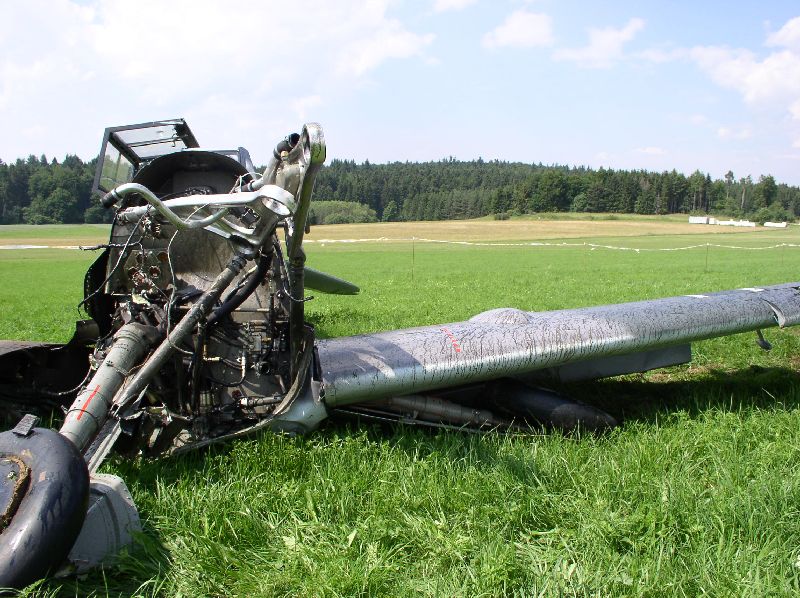
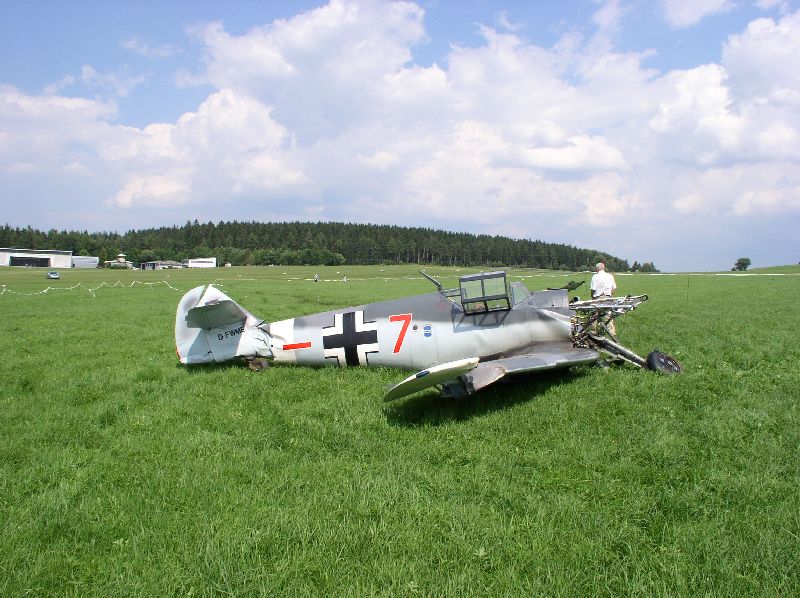
Red Seven Crashes in Denmark


A charmed life: This Me Bf 109 has survived 3 crashes.

The pilot was unhurt and the aircraft does not seem to have suffered heavy damage. The propeller is shattered and the engine will certainly have suffered, but the pilot’s decision to land in an unharvested wheat field probably helped to limit the damage to the airframe.

This is the third time that this aircraft has been damaged. It crashed in 2005 and, after being rebuilt, it made a wheels-up landing in 2008.

The Messerschmitt Stiftung's "Rote Sieben" (Red Seven) was built as a Hispano (CASA) license built Bf-109, the Hispano HA-1112 M-1L Buchón, Spain in 1950 with c/n 139. After delivery she first served with the Ejercito del Aire with serial C.4K-75.

After being stuck of charge she was stored on Tablada before being sold to the United Kingdom in 1968, registered as G-AWHH. She starred as a Bf-109E "yellow 11" and "red 14" in the famous movie "The Battle of Britain". 

For another role in a movie she was reconverted into a P-51 "Mustang". Therefore a fake belly-cooler was attached. But she unfortunately crashed during a take-off and was severely damaged.

After her accident she was sold to the USA being registered as N3109G and restored to flying condtion. She was flown for the first and last time from Casper, Wyoming in 1986 as she crashed on take-off. After she was "repaired" to represent an Bf-109E-4 in static condition and in open storage. 

She was in a poor state when she arrived in Augsburg, Germany in the 1990s where a couple of enthusiasts had the ambitious plan to restore her to Bf-109G-4 "Gustav" specifications, including the Daimler-Benz DB605 engine.

Her first owner gave up on the plan fairly soon an in 1998 she was moved to the Messerschmitt Air Company (MAC) at Albstadt-Degerfeld. There she would undergo an expensive and time consuming restoration, that took over 30.000 hours. The work was completed in 2004 and on October 8 of that year she was presented to the public; the Rote Sieben had come to life!

Image

On July 15, 2005 disaster struck as she was involved in a crash landing. While she touched down at her home, Albstadt-Degerfeld, the main gear collapsed resulting in a violent ground spin. The engine broke of the fuselage and the fighter was heavily damaged. 


Image

Image


At that point it wasn't clear if she would ever take the skies again. While being repaired the MAC was having difficulties to raise the funds to finalize the needed work and in December 2007 she was adopted by the Manching based Messerschmitt Stiftung. On April 2, 2008 she made, with Walter Eichhorn as her pilot, her first 15 minute test flight.
But then on April 15, 2008, just two weeks after her first flight, disaster struck again. While on approach to Manching, the pilot, Walter Eichhorn, found out that the right main gear of the 109 wasn't locked. After several attempts he found himself forced to make a wheels-up landing. 
Image


The "Rote Sieben" was damaged, but thanks to the superb landing of Eichhorn the damage was kept to a minimum. After the previous accident in 2005, this mend that yet another round of repairs where necessary. 

After the repairs were made the "Rote Sieben" made her first flight on February 19, 2009 with Walter Eichhorn as pilot.


ubehandlet_webpix_960nolkm.jpg


Now again belly landed in a corn field on August 18th 2013 during an airshow display at Roskilde Airport, Denmark. The pilot was unharmed, and the aircraft sustained only minor damage, including a completely broken propeller:


Amelia Earhart's sad demise

Dozens heard Amelia Earhart's final, chilling pleas for help, researchers say Distilled from 2 posts in the  Washington Post a...