Showing posts with label WW2. Show all posts

Sunday, 25 May 2014

Back to the Ju 87 Stuka: Part 3: Variants: Production models

Ju 87 Stuka Part 3:
Variants: Production Models


Ju 87B "Bertha"

The Ju 87 B series was to be the first mass-produced variant. A total of six pre-production Ju 87 B-0 were produced, built from Ju 87 A airframes. Test flights began from the summer of 1937. A small number, at least three, served as conversion Cs or Es for potential naval variants.


Junker Ju 87B.
[Source: Unknown]

The first production version was the Ju 87 B-1, with a considerably larger engine, its Junkers Jumo 211D generating 1,200 PS (883 kW, 1,184 hp), and completely redesigned fuselage and landing gear. This new design was again tested in Spain, and after proving its abilities there, production was ramped up to 60 per month. As a result, by the outbreak of World War II, the Luftwaffe had 336 Ju 87 B-1s on hand.


The B-1 was also fitted with "Jericho trumpets", essentially propeller-driven sirens with a diameter of 0.7 m (2.3 ft) mounted on the wing's leading edge directly forward of the landing gear, or on the front edge of the fixed main gear fairing. This was used to weaken enemy morale and enhance the intimidation of dive-bombing. After the enemy became used to it, however, they were withdrawn. The devices caused a loss of some 20–25 kph (10-20 mph) through drag. Instead, some bombs were fitted with whistles on the fin to produce the noise after release.


The trumpets were a suggestion from Generaloberst Ernst Udet (but some authors say the idea originated from Adolf Hitler). The Ju 87 B-2s that followed had some improvements and were built in a number of variants that included ski-equipped versions (the B-1 also had this modification), and at the other end, with a tropical operation kit called the Ju 87 B-2 trop.

Italy's Regia Aeronautica received a number of the B-2s and named them the "Picchiatello", while others went to the other members of the Axis, including Hungary, Bulgaria and Romania. The B-2 also had an oil hydraulic system for closing the cowling flaps. This continued in all the later designs.


Italian Air force Ju87B2-trop, forced down behind British Lines

The tropicalised versions were initially named the Ju 87 B-2/U1. This was eventually designated the Ju 87 B-2 trop, equipped with tropical emergency equipment and sand filters for the powerplant.

Production of the Ju 87 B started in 1937. 89 B-1s were to be built at Junkers' factory in Dessau and another 40 at the Weserflug plant in Lemwerder by July 1937. Production would be carried out by the Weserflug company after April 1938, but Junkers continued producing Ju 87 up until March 1940. Total production amounted to 697 B-1s (311 by Junkers, 386 by Weserflug) and 225 B-2s (56 by Junkers, 169 by Weserflug). The last Ju 87B rolled off the production lines in October 1940.

Ju 87R
A long range version of the Ju 87 B was also built, known as the Ju 87 R. They were primarily intended for anti-shipping missions. The Ju 87R had a B-series airframe with an additional oil tank and fuel lines to the outer wing stations to permit the use of two 300 L (79,25 US gal) under-wing drop tanks.

Junkers JU 87 R-2 STUKA May 1941

This increased fuel capacity to 1,080 litres (500 L in main fuel tank of which 480 L where usable + 600 L from drop tanks). To prevent overload conditions, bomb carrying ability was often restricted to a single 250 kg (550 lb) bomb if the aircraft was fully loaded with fuel.

Junkers Ju 87 R 13

Ju 87 R-3

The Ju 87 R-1 had a B-1 airframe with the exception of a modification in the fuselage which enabled an additional oil tank. This was installed to feed the engine due to the increase in range after the addition of the extra fuel tanks.

The Ju 87 R-2 had the same airframe as the B-2, and strengthened to ensure it could withstand dives of 600 kph (370 mph). The Jumo 211D in-line engine was installed, replacing the R-1s Jumo 211A. Due to an increase in overall weight by some 700 kg (1,540 lb), the Ju 87 R-2 was 30 kph (20 mph) slower than the Ju 87 B-1 and had a lower service ceiling. The Ju 87 R-2 had an increased range advantage of 360 km (220 mi). The R-3 and R-4 were the last R variants developed. Only a few were built.

The R-3 was an experimental tug for gliders and had an expanded radio system so the crew could communicate with the glider crew by way of the tow rope. The R-4 differed from the R-2 in the Jumo 211J powerplant.

Total production amounted to 972 Ju 87R (105 R-1, 472 R-2, 144 R-4), all built by Weserflug. The last Ju 87R rolled off the production lines in October 1941.

Ju 87 C


Ju 87 R2

On 18 August 1937, the RLM decided to introduce the Ju 87 Tr(C). The Ju 87 C was intended to be a dive and torpedo bomber for the Kriegsmarine. The type was ordered into prototype production and available for testing in January 1938. Testing was given just two months and was to begin in February and end in April 1938. The prototype V10 was to be a fixed wing test aircraft, while the following V11 would be modified with folding wings. The prototypes were Ju 87 B-0 airframes powered by Jumo 211 A engines. Owing to delays, the V10 was not completed until March 1938. It first flew on 17 March and was designated Ju 87 C-1. On 12 May, the V11 also flew for the first time. By 15 December 1939, 915 arrested landings on dry land had been made. It was found the arresting gear winch was too weak and had to be replaced. Tests showed the average braking distance was 20–35 metres (65–115 feet). The Ju 87 V11 was designated C-0 on 8 October 1938. It was fitted out with standard Ju 87C-0 equipment and better wing-folding mechanisms. The "carrier Stuka" was to be built at the Weserflug Company's Lemwerder plant between April and July 1940.


Among the "special" equipment of the Ju 87 C was a two-seat rubber dinghy with signal ammunition and emergency ammunition. A quick fuel dump mechanism and two inflatable 750 L (200 US gal) bags in each wing and a further two 500 L (130 US gal) bags in the fuselage enabled the Ju 87 C to remain afloat for up to three days in calm seas. On 6 October 1939, with the war already underway, 120 of the planned Ju 87 Tr(C)s on order at that point were cancelled. The intention was to launch them off the Graf Zeppelin CV1 class aircraft carriers:


Despite the cancellation, the tests continued using catapults:

Imagen


The Ju 87 C had a takeoff weight of 5,300 kg (11,700 lb) and a speed of 133 kph (82 mph) on departure. The Ju 87 could be launched with a SC 500 kg (1,100 lb) bomb and four SC 50 kg (110 lb) bombs under the fuselage. The C-1 was to have two MG 17s mounted in the wing with a MG 15 operated by the rear gunner. On 18 May 1940, production of the C-1 was switched to the R-1.
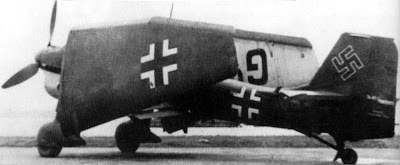

Junkers Ju 87 C.


Ju 87D "Dora"


Ju 87 D-5

Despite the Stuka's vulnerability to enemy fighters having been exposed during the Battle of Britain, the Luftwaffe had no choice but to continue its development, as there was no replacement aircraft in sight. The result was the D-series. In June 1941, the RLM ordered five prototypes, the Ju 87 V21–25. A Daimler-Benz DB 603 powerplant was to be installed in the Ju 87 D-1, but it did not have the power of the Jumo 211 and performed "poorly" during tests and was dropped. The Ju 87 D-series featured two coolant radiators underneath the inboard sections of the wings, while the oil cooler was relocated to the position formerly occupied by the coolant radiator.


The D-series also introduced an aerodynamically refined cockpit with better visibility and space. In addition, armor protection was increased and a new dual-barrel 7.92 mm MG 81Z machine gun with an extremely high rate of fire was installed in the rear defensive position. Engine power was increased again, the Ju mo 211J now delivering 1,420 PS (1,044 kW, 1,401 hp). Bomb carrying ability was nearly quadrupled from 500 kg (1,100 lb) in the B-version to 1,800 kg (3,970 lb) in the D-version (max. load for short ranges, overload condition), a typical bomb load ranged from 500-1,200 kg (1,100-2,650 lb).


The internal fuel capacity of the Ju 87D was raised to 800 L (of which 780 L were usable) by adding additional wing tanks while retaining the option to carry two 300 L drop tanks. Tests at Rechlin revealed it made possible a flight duration of 2 hours and 15 minutes. With an extra two 300 L (80 US gal) fuel tanks, it could achieve four hours flight time.


The D-2 was a variant used as a glider tug by converting older D-series airframes. It was intended as the tropical version of the D-1 and had heavier armour to protect the crew from ground fire. The armour reduced its performance and caused the Oberkommando der Luftwaffe to "place no particular value on the production of the D-2".

 The D-3 was an improved D-1 with more armour for its ground-attack role. A number of Ju 87 D-3s were designated D-3N or D-3 trop and fitted with night or tropical equipment. The D-4 designation applied to a prototype torpedo-bomber version, which could carry a 750–905 kg (1,650-2,000 lb) aerial torpedo on a PVC 1006 B rack.

The D-4 was to be converted from D-3 airframes and operated from the aircraft carrier Graf Zeppelin. Other modifications included a flame eliminator and, unlike earlier D variants, two 20 mm MG 151/20 cannon, while the radio operator/rear gunner's ammunition supply was increased by 1,000 to 2,000 rounds.


The Ju 87 D-5 was based on the D-3 design and was unique in the Ju 87 series as it had wings 0.6 metres (1 foot) longer than previous variants. The two 7.92 mm MG 17 wing guns were exchanged for more powerful 20 mm MG 151/20s to better suit the aircraft's ground-attack role. The window in the floor of the cockpit was reinforced and four, rather than the previous three, aileron hinges were installed. Higher diving speeds were obtained of 650 kph (408 mph) up to 2,000 m (6,560 ft). The range was recorded as 715 km (443 mi) at ground level and 835 km (517 mi) at 5,000 m (16,400 ft).


The D-6, according to "Operating instructions, works document 2097", was built in limited numbers to train pilots on "rationalised versions". However, due to shortages in raw materials, it did not go into mass production. The D-7 was another ground attack aircraft based on D-1 airframes upgraded to D-5 standard (armor, wing cannons, extended wing panels), while the D-8 was similar to the D-7 but based on D-3 airframes. The D-7 and D-8 were both were fitted with flame dampers, and could conduct night operations.
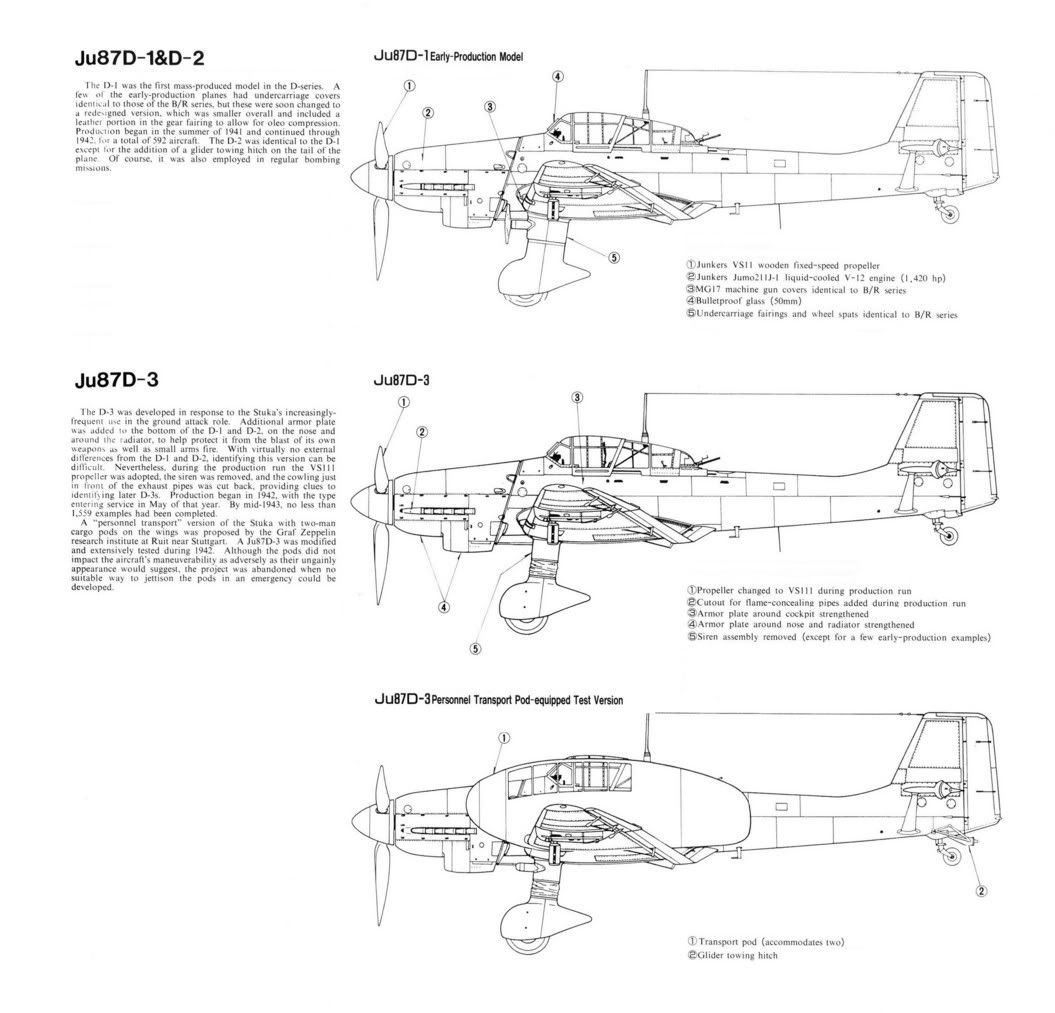
Production of the D-1 variant started in 1941 with 495 ordered. These aircraft were delivered between May 1941 and March 1942. The RLM wanted 832 machines produced from February 1941. The Weserflug company was tasked with their production. From June to September 1941, 40 Ju 87 Ds were expected to be built, increasing to 90 thereafter. Various production problems were encountered. Just one of the planned 48 was produced in July. Of the 25 the RLM hoped for in August 1941, none were delivered. Only in September 1941 did the first two of the planned 102 Ju 87s roll off the production lines. The shortfalls continued to the end of 1941. During this time, the WFG plant in Lemwerder moved production to Berlin. Over 165 Ju 87s had not been delivered and production was only 23 Ju 87 Ds per month out of the 40 expected. By the spring of 1942 to the end of production in 1944, 3,300 Ju 87s, mostly D-1s, D-2s and D-5s had been manufactured.
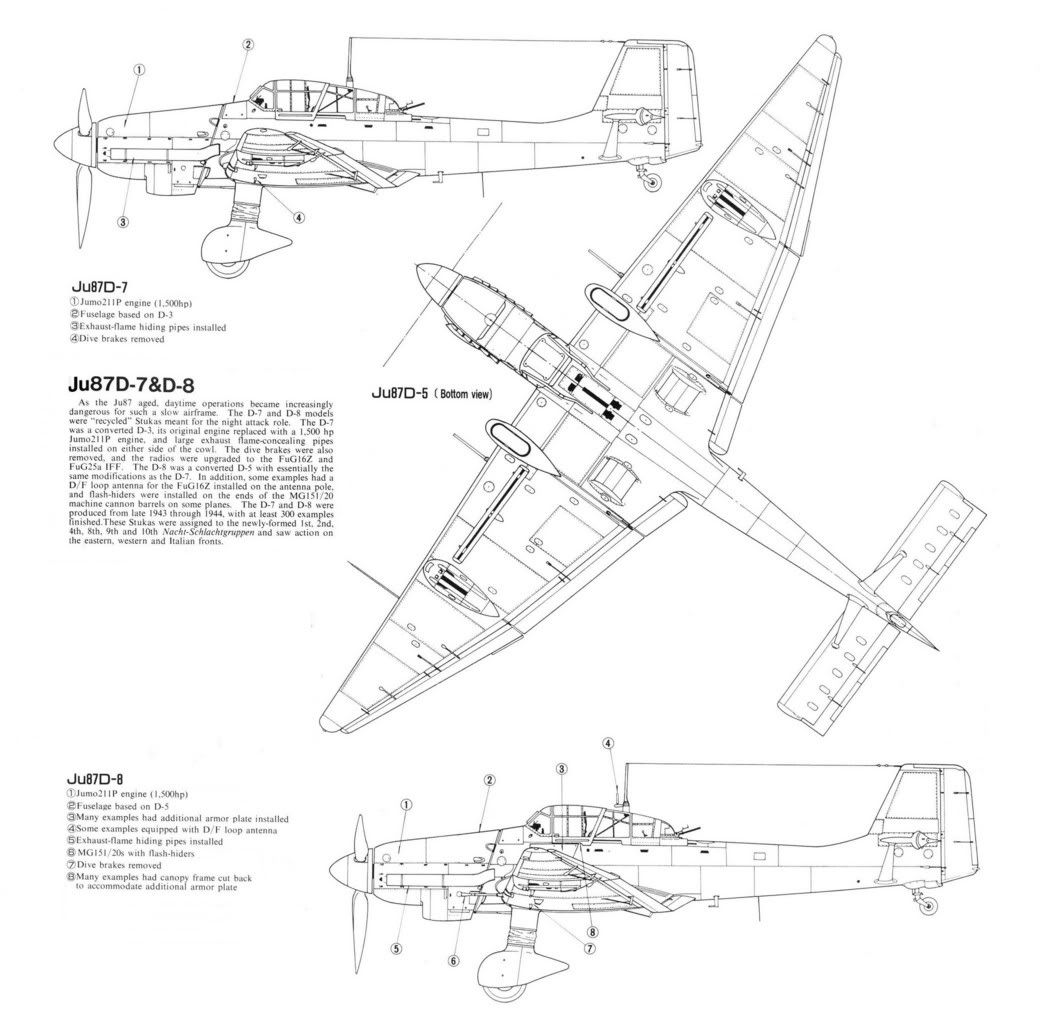


Total production amounted to 3639 Ju 87D (592 D-1, 1559 D-3 and 1448 D-5), all built by Weserflug. The last Ju 87 D-5 rolled off the production lines in September 1944.


The Ju 87 E and F proposals were never built, and Junkers went straight onto the next variant. Another variant derived from the Ju 87D airframe, the Ju 87H saw service as a dual-control trainer.


In January 1943, a variety of Ju 87 Ds became "test beds" for the Ju 87 G variants. At the start of 1943, the Luftwaffe test centre at Tarnewitz tested this combination from a static position. Oberst G. Wolfgang Vorwald noted the experiments were not successful, and suggested the cannon be installed on the Messerschmitt Me 410. However, testing continued, and on 31 January 1943, Ju 87 D-1 W.Nr 2552 was tested by Hauptmann Hans-Karl Stepp near the Briansk training area. Stepp noted the increase in drag, which reduced the aircraft's speed to 259 kph (162 mph). Stepp also noted that the aircraft was also less agile than the existing D variants. D-1 and D-3 variants operated in combat with the 37 mm (1.46 in) BK 37 cannon in 1943.


Ju 87G "Gustav"
With the G variant, the aging airframe of the Ju 87 found new life as an anti-tank aircraft. This was the final operational version of the Stuka, and was deployed on the Eastern Front. The reverse in German military fortunes after 1943 and the appearance of huge numbers of well-armoured Soviet tanks caused Junkers to adapt the existing design to combat this new threat. The Hs 129B had proved a potent ground attack weapon, but its large fuel tanks made it vulnerable to enemy fire, prompting the RLM to say "that in the shortest possible time a replacement of the Hs 129 type must take place." With Soviet tanks the priority targets, the development of a further variant as a successor to the Ju 87D began in November 1942. On 3 November, Erhard Milch raised the question of replacing the Ju 87, or redesigning it altogether. It was decided to keep the design as it was, but to upgrade the powerplant to a Jumo 211J, and add two 30 mm (1.18 in) cannon. The variant was also designed to carry a 1,000 kg (2,200 lb) free-fall bomb load. Furthermore, the armoured protection of the Ilyushin Il-2 Sturmovik was copied - a feature pioneered by the 1916-17 origin Junkers J.I of World War I Imperial Germany's Luftstreitkräfte - to protect the crew from ground fire now that the Ju 87 would be required to conduct low level attacks.


Junkers Ju 87G.
[Source: Unknown]

Hans-Ulrich Rudel, a Stuka ace, had suggested using two 37 mm (1.46 in) Flak 18 guns, each one in a self-contained under-wing gun pod, as the Bordkanone BK 3,7, after achieving success against Soviet tanks with the 20 mm MG 151/20 cannon.


These gun pods were fitted to a Ju 87 D-1, W.Nr 2552 as "Gustav the tank killer". The first flight of the machine took place on 31 January 1943, piloted by Hauptmann Hans-Karl Stepp. The continuing problems with about two dozens of the Ju 88P-1, and slow development of the Hs 129 B-3, each of them equipped with a large Bordkanone BK 7,5 cm (2.95 in) cannon in a conformal gun pod beneath the fuselage, meant the Ju 87G was put into production.


Winter Camo

In April 1943, the first production Ju 87 G-1s were delivered to front line units. The two 37 mm (1.46 in) cannons were mounted in under-wing gun pods, each loaded with a six-round magazine of armour-piercing tungsten carbide ammunition. With these weapons, the Kanonenvogel ("cannon-bird"), as it was nick named, proved spectacularly successful in the hands of Stuka aces such as Rudel. The G-1 was converted from older D-series airframes, retaining the smaller wing, but without the dive brakes. The G-2 was similar to the G-1 except for use of the extended wing of the D-5. 208 G-2s were built and at least a further 22 more were converted from D-3 airframes.
Junkers Ju 87 Stuka


37mm Flak 18 mounted on a Junkers Ju 87G.
[Source: Unknown]

Only a handful of production Gs were committed in the Battle of Kursk. On the opening day of the offensive, Hans-Ulrich Rudel flew the only "official" Ju 87 G, although a significant number of Ju 87D variants were fitted with the 37 mm (1.46 in) cannon, and operated as unofficial Ju 87 Gs before the battle. In June 1943, the RLM ordered 20 Ju 87Gs as production variants. The G-1 later influenced the design of the A-10 Thunderbolt II, with Hans Rudel's book, Stuka Pilot being required reading for all members of the A-X project.


Night-harassment variants

The Soviet Air Force practice of harassing German ground forces using antiquated Polikarpov Po-2 and R-5 biplanes at night to drop flares and fragmentation bombs, inspired the Luftwaffe to form its own Störkampfstaffeln (harassment squadrons). On 23 July 1942, Junkers offered the Ju 87 B-2, R-2 and R-4s with Flammenvernichter ("flame eliminators"). On 10 November 1943, the RLM GL/C-E2 Division finally authorised the design in directive No. 1117. This new equipment made the Ju 87 more difficult to detect from the ground in darkness.

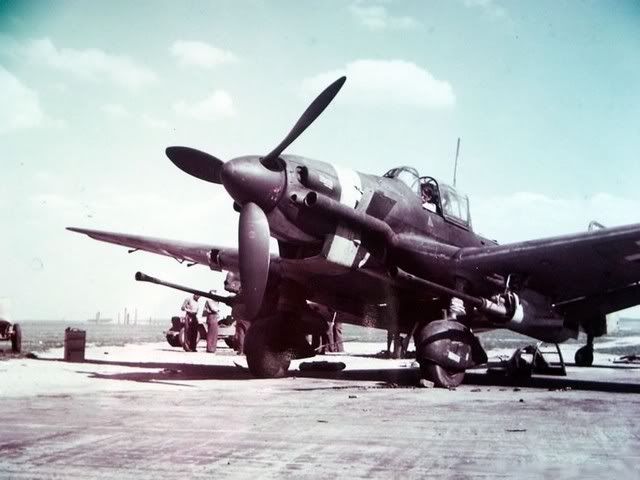


Note the flame suppressors on the exhausts


Pilots were also asked to complete the new "Blind Flying Certificate 3", which was especially introduced for this new type of operation. Pilots were trained at night, over unfamiliar terrain, and forced to rely on their instruments for direction. The Ju 87's standard Revi C12D gunsight was replaced with the new Nachtrevi ("Nightrevi") C12N. On some Ju 87s, the Revi 16D was exchanged for the Nachtrevi 16D. To help the pilot see his instrument panel, a violet light was installed. On 15 November 1942, the Auxiliary Staffel were created. By mid-1943, Luftflotte 1 was given four Staffeln while Luftflotte 4 and Luftwaffe Kommando Ost (Luftwaffe Command East) were given six and two respectively.

 In the first half of 1943, 12 Nachtschlachtgruppen had been formed, flying a multitude of different types of aircraft, including the Ju 87, which proved itself ideally suited to the low-level slow flying needed.

Unusual operators:

Saturday, 17 May 2014

SAAF C-47 Dakotas -The Early Days: WW2 and Berlin Air Lift

SAAF Dakotas: WW2 and Berlin Air Bridge - The Early Days


The Douglas C-47 Skytrain or Dakota is a military transport aircraft that was developed from the Douglas DC-3 airliner. It was used extensively by the Allies during World War II and remained in front line operations through the 1950s with a few remaining in operation to this day. 


WW2 SAAF and The Dak - The love affair starts:


The East African Campaign led to the creation of the Shuttle Service operated by 50 (TS) Squadron under the control of 1 Bomber Transport Brigade. The latter unit became 5 Wing in February 1941 and was responsible for the ferrying of troops and supplies to the war front and bringing back wounded. The service was extended to Cairo as the war progressed and eventually through the north of Africa to Bari and Rome by which time Dakotas were in use.

The Shuttle Service was greatly expanded at the war’s end, the intention being the return of all South African troops by Christmas 1945. The Dakotas of 5 Wing were joined by Venturas withdrawn from coastal operations, modified as transports and put into service with 10 Wing at Pietersburg. These two units were assisted by 35 Sqn’s Sunderlands which were also fitted out as transports. Additional Dakotas were provided by 28 Sqn when it returned home from the war zone. By 25 January 1946 some 101 676 passengers had been carried.

The first SAAF Transport squadron in the Mediterranean - 28 Sqn - was formed in May 1943 operation from Tripoli and later Algiers. The second squadron - 44 Sqn - was established in March 1944 and operated from Cairo.

Both units operations Douglas Dakotas as standard equipment although a small number of Wellingtons, Ansons and Beech Expediters were also used.

In October 1945, 28 Sqn was absorbed into the Shuttle Service while 44 Sqn was disbanded in December 1945, and its Dakotas were returned to the RAF.

The first Douglas C-47 Dakota to serve with the SAAF was delivered to 44 Squadron in Cairo on 27 April 1944 and served with the squadron until 1992 when they were replaced by converted C-47TP versions. 


WW2 North Africa/Med Camo SAAF C-47

SAAF Dak in East Africa


Troups enroute back to SA


Curiosity: Not a Dak, but a Captured JU 52 in SAAF colours

6856


Distinguished SAAF Dakota passengers: 
Prof JLB Smith, Mr Lattimer and the Coelecanth
More about the Coelecanth: Old Four-Legs

The Berlin Air Lift


In 1948, the relations between the Western Allies and their Soviet counterparts had deteriorated to such a degree that the Soviets instituted a blockade on all rail, road and water canal links into West Berlin, situated 177 km (110 miles) into Soviet occupied Germany. The only way into Berlin was via three air corridors agreed upon at the Potsdam Conference in 1945.


The Berlin Wall being built


 It was decided to sustain the population of West Berlin by air, a feat that the Soviet Union had never anticipated. Thus, the Berlin airlift began on 24 June 1948.
The SAAF supplied 20 aircrews for the Berlin Airlift, with the crews flying to Britain in Dakotas via east Africa, Egypt and Malta, a journey that took five days. They then joined the Royal Air Force in flying sorties into Berlin. The SAAF crews flew 2 500 sorties and carried a total of 8 333 tons of humanitarian aid while flying RAF Dakotas.


The sorties were flown from Lubeck in West Germany into RAF Gatow in West Berlin. In addition to this, civilian members in need of evacuation from occupied Berlin were carried on return trips to Lubeck, especially orphaned children who were placed with families in the West. It was here that modern air traffic control procedures were developed.

In all, during the 406 days of the Berlin Airlift, American, British and Commonwealth air crews carried out 300 000 flights and transported two million tons of supplies.
The Soviet blockade Berlin was lifted at one minute after midnight, on 12 May 1949.
Flights continued for some time, though, to build a comfortable surplus. By 24 July 1949, a three-month surplus was built-up, ensuring that the airlift could be re-started with ease if needed. The Berlin Airlift officially ended on 30 September 1949, after fifteen months.


Communications
There were four different means of entering Berlin from the West: by river and canal barges; road transport; the railways; and three air corridors which traversed the Soviet zone of occupation. While there was a written agreement with the Soviets regarding the use of the air corridors, nothing existed in writing about access to Berlin by any of the surface routes.


The central air control zone for Berlin covered a 20 mile (32 km) radius from the centre of the city and was under Four Power control. Most air routes into the city's existing airfields required some flying over the Soviet Sector of Berlin, as well as traversing well over 100 miles (160 km) of Soviet-occupied Germany. The North and Central Air Corridors came from the British zone of occupation and the South Air Corridor from the American zone.

First map
Air communications with Berlin 1948-9
High resolution pdf version of map


At the start of the airlift, West Berlin had two airfields which were situated twelve kilometres apart: Tempelhof (in the American Sector) was the original aerodrome of Berlin; and Gatow (in the British Sector) was a grass airfield which had originally been used for training and had a short runway of perforated steel planking (PSP). To augment these rather inadequate facilities, a third airfield, Tegel, was built in the French Sector during the Airlift by some 19 000 Berliners using rubble from bombed buildings. The necessary heavy construction machinery was transported into Berlin in small pieces in an unusual-looking aircraft, the Bristol Wayfarer. These aeroplanes were designed to carry cars across the English Channel and had an elevated cockpit situated above large doors in the nose, through which the parts of these heavy machines were able to pass. The appearance of these ungainly-looking aircraft with their fixed undercarriages led to many jokes amongst the American airlift aircrews, who nicknamed them the 'Mayflowers'.


The airlift begins
On 26 June, the United States Air Force and the Royal Air Force (RAF) began the Airlift, using a few DC3 Dakota aircraft (known in the US Air Force as the C47). These aeroplanes were capable of lifting only three tons on each flight and, on the first day of operations, only eighty tons of supplies arrived in Berlin. (The minimum amount required to sustain the city was initially calculated at 5 000 tons per day, 150 000 tons per month). Fortunately the Western powers in Berlin had begun stockpiling when the Soviets had commenced their harrassing tactics and therefore, when the blockade began, there were sufficient supplies in Berlin to last, on average, six to eight weeks.
Civilian rations were reduced to 1 000 calories per person per day
    The American airlift was called 'Operation Vittles' (after an old English word for 'food') and they provided the lion's share of the aircraft. Some 441 American aircraft were used in total and they carried over three-quarters of the entire load into Berlin. British and Commonwealth air forces supplied 147 aircraft and carried 17% of the load, whilst British civil operators provided a further 104 aircraft and lifted just over six per cent of the load. At the commencement of the Airlift, many countries of the British Commonwealth, including South Africa, offered their assistance. With the exception of the Canadians, these Commonwealth countries provided crews to fly RAF aircraft. South Africa sent ten complete Dakota crews, who flew for almost the whole period of the Airlift alongside their RAF colleagues.
    In the first month of the Airlift, a total of 70 241 tons of supplies was flown in to Berlin, just under half of the minimum needs of the city. By the end of the Airlift, the monthly total had risen to over 250 000 tons and this was probably one of the main contributing factors that convinced the Soviets that there was no future in maintaining the blockade. Compared with the amount of cargo which had to be moved, the capacity of the aircraft used in the Airlift necessitated a staggering number of flights. The Dakotas could carry only three tons, the Wayfarers five and a half tons and the Yorks, Skymasters, Hastings, Tudors and flying boats between eight and ten tons each. The aircrews themselves made a number of recommendations regarding the removal of standard fittings like oxygen equipment and dinghies, which were not considered necessary.

    During the Airlift, the British and the Americans shared the three air corridors permitted under the original four-power agreement. Aircraft based in the British zone entered Berlin along the Northern Air Corridor and the American aircraft came in along the Southern Corridor. Aircraft leaving Berlin generally used the Central Corridor. However, some British aircraft that were based very far north in their zone, also left along the Northern Corridor. Since the Americans provided the largest number of the aircraft and their bases were the furthest from Berlin, the British made two of their airfields at Celle and Fassburg in the centre of Germany available for use by the Americans, thereby greatly reducing their flying time, and also allowed them to share the Northern Corridor.

    Flying boats
    A unique aircraft type, probably unknown to most people today, were the 'flying boats' which were also used during the Airlift. These aircraft were once a familiar sight to South Africans - operating on the air routes between the Union and Britain before and immediately after the Second World War. During the Airlift, flying boats operated from the marine base of Finkenwerder on the River Elbe on the outskirts of Hamburg to a base on the Havel See (Havel Lake) in Berlin. Apart from increasing the number of available aircraft, the flying boats were also used to carry most of the salt supplies, as their hulls had been treated against the corrosive effects of the salt water on which they normally landed.


     (Land-based aircraft, lacking this anti-corrosion treatment, soon showed dangerous levels of corrosion due to salt cargo spillages and seepage. Having no night landing aids the flying boats operated only in the daytime from July until December 1948, when the Havel See became covered with ice. They did not resume operation after the Spring thaw.

    Harrassment
    Throughout the Airlift, the Soviets used a variety of means to harrass the air crews and to work on their fatigued nerves. For example, Soviet fighter aircraft played 'chicken' with the heavily-laden transports and carried out air-to-ground firing exercises with live ammunition very close to the corridors. The Soviet Army's anti-aircraft batteries also used live ammunition in exercises which took place as close as possible to the boundaries of the corridors and they flew barrage balloons alongside the corridors and held seeming endless conversations on the radio frequencies allocated to the Allied aircraft.


    Discomfort of the crews
    Apart from the fatigue caused by flying a number of operations daily under the most arduous of conditions, the crews lived in great discomfort. Their accommodation was either close to the airfields where the noise of the continuous flying operations made rest and sleep difficult, or they lived some distance away, requiring travelling between airfield and base which cut badly into their rest intervals. Furthermore, coal (the major cargo item) and flour produced prodigious quantities of dust which clogged flying controls and permeated the clothes of the air crews.

    Berlin children
    Conditions in occupied Germany were very severe and many people were reduced to begging. This was especially true of the children, who would follow the servicemen, calling out 'Got any gum, chum?' (probably the first words of English that they learned). A young American pilot, Lieutenant Gail Halvorsen, was sent on a familiarisation flight to Templehof and went on foot around the airfield to learn the approaches. He noticed a group of children who were standing at the fence close to the end of the runway and who were watching the aircraft coming in to land. Strangely, they did not beg when they saw him. Searching his pockets, Halvorsen found a few sticks of gum and a chocolate bar which he divided amongst some of them and promised that, if they were there the next day, he would drop some candy to them when he came in to land. When the children asked how they would know his aircraft, he told them that he would waggle his wings during his approach.


    Returning to his base, Lt Halvorsen made several small parachutes out of a large supply of handkerchiefs which he had bought for a heavy cold. To each he attached a chocolate bar. On reaching Berlin the next morning he found the end of the runway crowded with children. His flight engineer dropped the little parachutes out of the flare chute and they were eagerly grabbed by the waiting children. This procedure was repeated every day and soon many Airlift crews joined in what became known as 'Operation Little Vittles'.

    Der Schokoladenflieger
    Halvorsen received two nicknames - 'Der Schokoladenflieger' (the chocolate pilot) and 'Uncle Wigglywings' - and German children sent him so much fan mail that his commanding officer had to provide him, a junior officer, with a German-speaking secretary to handle the replies. At Christmas Halvorsen received over 4 000 Christmas cards!


     Halvorsen meeting the kids for the first time

    When children from the Soviet Sector of Berlin wrote and complained that they were being left out, Halvorsen and his comrades started dropping chocolates over the eastern sector as well, until the Soviet authorities ordered this to cease. The trail of little parachutes eventually became a danger to approaching aircraft and an official 'dropping zone' was established over open ground in the Tiergarten Park.

    The Air Police at the US bases began to offer minor offenders the choice of a fine or a contribution of chocolate for 'Operation Little Vittles'. Halvorsen himself was sent back to the USA on a public relations tour. He received thousands of handkerchiefs in the post, some with lace edges, drenched with perfume and with the donors' telephone numbers on them.


    In May 1998, the US Air Force sent one of its few surviving C54 Skymaster aircraft to Berlin to take part in the 50th anniversary celebrations. Gail Halvorsen was a member of the crew for this flight.

    In 1948, the Operation "little Vittles", gave hope to Berlin people by dropping  around 23 tons of chocolates and candies over Germany. This operation was begun by Gail Halvorsen.

    Reducing weight
    Various measures were taken to reduce the mass of the supplies which were being flown into Berlin during the Airlift. Known for their great love of potatoes, which they served up in a large variety of ways, the Berliners did not much like the dehydrated potato powder called 'Pom', with which they were supplied. However, as this cut down some 780 tons daily, the housewives of Berlin made the best of the situation with a saying: 'Better Pom than Frau komm!' As water makes up a quarter of the weight of bread, the ingredients were flown in and the bread was baked inside Berlin, while meat was de-boned to reduce its weight by 25%. In this way, Berlin's food requirements were successfully reduced from 2 000 tons to 1 000 tons a day.

    The end of the blockade
    The Soviets realised that they were neither going to be able to drive the Allies out of Berlin nor stop the Airlift. Tunner's Easter Parade demonstration had coincided with the signing of the North Atlantic Treaty which bound twelve countries together in a defence pact. In addition, the Allies had started turning back all trucks passing through the western zones of Germany, which were destined for the East, and so the Soviet zone was being starved of essential raw materials like coal and iron from the Ruhr.

    On 12 May 1949, the blockade of Berlin was finally lifted. The Soviets tried to impose farther technical restrictions on movements from the West into Berlin but these were soon brushed aside by the Allies. In order to rebuild the stockpiles in West Berlin, the airlift continued for several months. British civil aircraft were finally withdrawn on 16 August and the RAF on 23 September, a few days after the SAAF crews had returned home.

    Statistics
    The statistics of the Airlift are as follows:
    Estimated cost: US$ 200 million (For a reasonable present day comparison, this figure should be multiplied by at least 100)
    Total number of aircraft used: 692
    Total distance flown: 124 420 813 miles (equivalent to thirteen round trips to the moon or 4 000 times around the world)
    Total number of flights: 277 804
    Total tonnage into Berlin: 2 352 809
    Coal: 1 586 530 tons (67%)
    Food: 538 016 tons (23%)
    Liquid fuel: 92 282 tons (4%)
    Casualties: 65 men lost their lives -
      31 Americans
      8 RAF
      11 British civilian crew
      5 Germans
    A monument representing the Air Bridge stands in the west of Berlin and is inscribed with the names of those who died. In addition, the people of Berlin raised a fund to secure the education and the futures of all the children of those who gave their lives for their city.


       Air Bridge Memorial

    The last RAF flight
    The last RAF flight from Lübeck landed at Gatow at 19.22 on 23 September 1949. The Dakota, appropriately carrying a load of coal, was inscribed with the following words:
    'Positively the last load from Lübeck - 73 705 tons - Psalm 21 verse 11'. (In the King James version of the Bible, this verse reads: 'For they intended evil against thee, they imagined a mischevious device which they were not able to perform' - perhaps a suitable epitaph for the Berlin Airlift).

    SOURCES
    Collier, R, Bridge across the Sky (Macmillan, London, 1978)
    Jackson, R, The Berlin Airlift (Patrick Stephens, Wellingborough, 1988)
    Maree, B, 'The Berlin Airlift' in South African Panorama, December 1988, pp 14-18.
    Morris, E, Blockade, Berlin & the Cold War (Military Book Society, London, 1973)
    Personal reminiscences of Maj Gen Duncan Ralston; Col Peter MacGregor; and Capt Anthony Speir.

    Amelia Earhart's sad demise

    Dozens heard Amelia Earhart's final, chilling pleas for help, researchers say Distilled from 2 posts in the  Washington Post a...