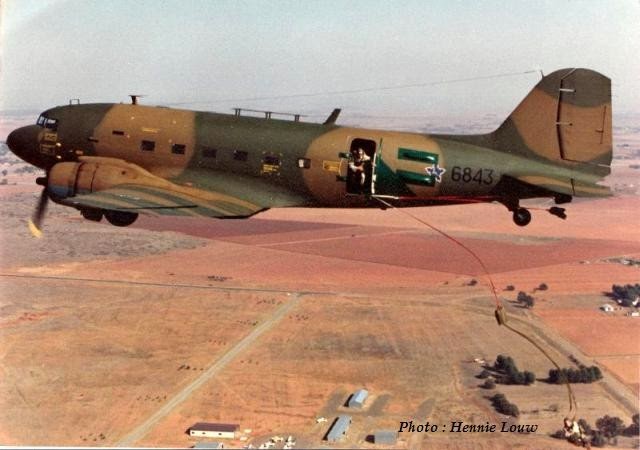
Showing posts with label Gooney. Show all posts

Friday, 16 May 2014

AC-47 Dakota Gunship: Spooky and Puff The Magic Dragon SAAF and USA

Dakota Part 5: 

Douglas AC-47 Spooky / Puff, the Magic Dragon / Dragon Dak


The Douglas AC-47 Spooky (also nicknamed "Puff, the Magic Dragon") was the first in a series of gunships developed by the United States Air Force during the Vietnam War. More firepower than could be provided by light and medium ground-attack aircraft was thought to be needed in some situations when ground forces called for close air support.


British "Waist-gunners" using Lewis Guns in WW2, 
mostly for anti-aircraft purposes rather than ground attack

Late in World War II, an Army Air Force lieutenant named Gilmour C. MacDonald had come up with the idea of mounting side-firing weapons in aircraft for the ground attack mission. The pilot of a conventional attack aircraft had to make a pass on a target and fire his weapons, then come around for another pass. The pilot of an attack aircraft with side-firing weapons could simply perform a banking "pylon turn" around a target, line up the target along his wingtip, and then hose it down with a "cone of fire" for as long as ammunition held out.

Nothing came of the idea until 1961, when MacDonald, by then a USAF lieutenant colonel, brought it up again and managed to inspire a set of shoestring demonstrations of the concept. By 1964, it was the right idea in the right place. The USAF was trying to come to grips with the difficulties of fighting the growing jungle war in Southeast Asia, in particular casting about for a way to perform effective close air support for ground operations. 

In August of that year, the war had undergone a drastic escalation with the the Tonkin Gulf incident. In November, a USAF captain named Ronald W. Terry sold the idea of a gunship to the brass, and was authorized to put together two gunships quickly for a combat evaluation. MacDonald was the father of the idea of the side-firing gunship, but Terry was the one who would make it work.

The initial two Dakota gunships were in Vietnam by December and in combat before the end of the year. The gunships were originally given the designation of "FC-47D", but this was quickly changed to "AC-47D" in response to loud complaints by fighter pilots that calling any kind of a C-47 a "fighter" was really stretching the definition of the term.

The AC-47Ds was fitted with three 7.62 millimeter (0.30 caliber) Gatling-style Miniguns firing out the left side of the aircraft. The Miniguns had a selectable rate of fire of 3,000 or 6,000 rounds per minute, and the gunship typically carried about 24,000 rounds of ammunition. Early gunships used improvised cargo-hold mounts for standard SUU-11A/A Minigun pods, the pod having been designed as an underwing store. Later gunships carried GAU-2B/A Miniguns more specifically rigged for the task, and then the far more satisfactory MXU-470/A Miniguns, which used an ammunition drum instead of a belt-feed from ammunition cans, with great improvement in convenience and reliability. After some experience, the guns would be fixed pointing 12 degrees downward, reducing the aircraft bank angle required for attacks.

Electrically operated miniguns


Ballistic armor curtains were fitted to the left side of the aircraft to protect crew and systems; new radio and navigation equipment were installed; a Mark 20 gun sight salvaged from the Douglas A-1 Skyraider attack aircraft was fitted to the cockpit left-side window; and a trigger button from the same source was attached to the pilot's control wheel. The AC-47Ds also carried a bin of illumination flares for night fighting next to the cargo door, with the flares tossed out of the aircraft by the flight crew by hand. The bin was later armored to prevent the flares from being set off by ground fire.

Vietnamese who observed attacks by the gunships compared them to roaring, fire-spouting dragons, and so the gunships acquired the name "Puff", after a contemporary pop tune, "Puff the Magic Dragon". They were more informally called "Spooky" after their radio call-sign, and were well-liked by US ground forces for their ability to literally rip enemy assaults to shreds.


The modified craft's primary function was close air support for ground troops. Other armament configurations could also be found on similar C-47-based aircraft around the world. The guns were actuated by a control on the pilot's yoke whereby he could control the guns either individually or together, although gunners were also among the crew to assist with gun failures and similar issues. It could orbit the target for hours, providing suppressing fire over an elliptical area approximately 52 yd (47.5 m) in diameter, placing a round every 2.4 yd (2.2 m) during a three-second burst. The aircraft also carried flares it could drop to illuminate the battleground.


Spent casings after a Vietnam mission


The AC-47 had no previous design to gauge how successful it would be because it was the first of its kind. The USAF found itself in a precarious situation when requests for additional gunships began to come in because it simply lacked miniguns to fit additional aircraft after the first two conversions. The next four aircraft were equipped with 10 .30 caliber AN/M2 machine guns. However, these weapons, using World War II and Korean War ammunition stocks, were quickly discovered to jam easily, produce large amounts of gases from firing, and, even in 10-gun groups, only provide the density of fire of a single minigun. All four of these aircraft were retrofitted to the standard armament configuration when additional miniguns arrived.


The AC-47 initially used SUU-11/A gun pods that were installed on locally fabricated mounts for the gunship application. Emerson Electric eventually developed the MXU-470/A to replace the gun pods, which were also used on subsequent gunships.


Miniguns at the ready


Flare canister


In August 1964, years of fixed-wing gunship experimentation reached a new peak with Project Tailchaser under the direction of Capt. John C. Simons. This test involved the conversion of a single Convair C-131B to be capable of firing a single GAU-2/A Minigun at a downward angle out of the left side of the aircraft. Even crude grease pencil crosshairs were quickly discovered to enable a pilot flying in a pylon turn to hit a stationary area target with relative accuracy and ease. The Armament Development and Test Center tested the craft at Eglin Air Force Base, Florida, but lack of funding soon suspended the tests. In 1964, Capt. Ron W. Terry returned from temporary duty in Vietnam as part of an Air Force Systems Command team reviewing all aspects of air operations in counter-insurgency warfare, where he had noted the usefulness of C-47s and C-123s orbiting as flare ships during night attacks on fortified hamlets. He received permission to conduct a live-fire test using the C-131 and revived the side-firing gunship program.
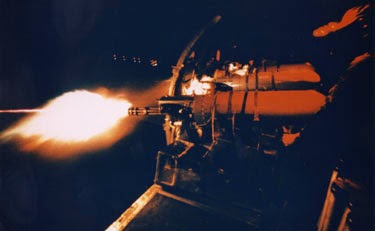

Minigun in action

By October, Capt. Terry's team under Project Gunship provided a C-47D, which was converted to a similar standard as the Project Tailchaser aircraft and armed with three miniguns, which were initially mounted on locally fabricated mounts—essentially strapped gun pods intended for fixed-wing aircraft (SUU-11/A) onto a mount allowing them to be fired remotely out the port side. Captain Terry and a testing team arrived at Bien Hoa Air Base, South Vietnam, on 2 December 1964, with equipment needed to modify two C-47s. The first test aircraft (43-48579, a C-47B-5-DK mail courier converted to C-47D standard by removal of its superchargers) was ready by 11 December, the second by 15 December, and both were allocated to the 1st Air Commando Squadron for combat testing. The newly dubbed "FC-47" often operated under the radio call sign "Puff". Its primary mission involved protecting villages, hamlets, and personnel from mass attacks by VC guerrilla units.


Spooky in Vietnam

Puff's first significant success occurred on the night of 23–24 December 1964. An FC-47 arrived over the Special Forces outpost at Tranh Yend in the Mekong Delta just 37 minutes after an air support request, fired 4,500 rounds of ammunition, and broke the Viet Cong attack. The FC-47 was then called to support a second outpost at Trung Hung, about 20 miles away. The aircraft again blunted the VC attack and forced a retreat. Between 15 and 26 December, all the FC-47's 16 combat sorties were successful. On 8 February 1965, an FC-47 flying over the Bong Son area of Vietnam’s Central Highlands demonstrated its capabilities in the process of blunting a Viet Cong offensive. For over four hours, it fired 20,500 rounds into a Viet Cong hilltop position, killing an estimated 300 Viet Cong troops.


Twin Browning arrangement


Gatling Minigun replacement

The early gunship trials were so successful, the second aircraft was returned to the United States early in 1965 to provide crew training. In July 1965, Headquarters USAF ordered TAC to establish an AC-47 squadron. By November 1965, a total of five aircraft were operating with the 4th Air Commando Squadron, activated in August as the first operational unit, and by the end of 1965, a total of 26 had been converted. Training Detachment 8, 1st Air Commando Wing, was subsequently established at Forbes AFB, Kansas. In Operation Big Shoot, the 4th ACS in Vietnam grew to 20 AC-47s (16 aircraft plus four reserves for attrition).

Spooky inbound

The 4th ACS deployed to Tan Son Nhut Air Base, Vietnam, on 14 November 1965. Now using the call sign "Spooky", each of its three 7.62 mm miniguns could selectively fire either 50 or 100 rounds per second. It can be seen in action here. Cruising in an overhead left-hand orbit at 120 knots air speed at an altitude of 3,000 ft, the gunship could put a bullet or glowing red tracer (every fifth round) bullet into every square yard of a football field-sized target in potentially less than 10 seconds.[dubious – discuss] And, as long as its 45-flare and 24,000-round basic load of ammunition held out, it could do this intermittently while loitering over the target for hours.


On the ground with an early model Hercules C130 A (note the short nose)

In May 1966, the squadron moved north to Nha Trang Air Base to join the newly activated 14th Air Commando Wing. The 3rd Air Commando Squadron was activated at Nha Trang on 5 April 1968 as a second AC-47 squadron, with both squadrons re-designated as Special Operations Squadrons on 1 August 1968. Flights of both squadrons were stationed at bases throughout South Vietnam, and one flight of the 4th SOS served at Udorn Royal Thai Air Force Base with the 432nd Tactical Reconnaissance Wing. The superb work of the two AC-47 squadrons, each with 16 AC-47s flown by aircrews younger than the aircraft they flew, was undoubtedly a key contributor to the award of the Presidential Unit Citation to the 14th Air Commando Wing in June 1968.

One of the most publicized battles of the Vietnam War was the siege of Khe Sanh in early 1968, known as "Operation Niagara". More than 24,000 tactical and 2700 B-52 strikes dropped 110,000 tons of ordnance in attacks that averaged over 300 sorties per day. During the two and a half months of combat in that tiny area, fighters were in the air day and night. At night, AC-47 gunships kept up a constant chatter of fire against enemy troops. During darkness, AC-47 gunships provided illumination against enemy troops.
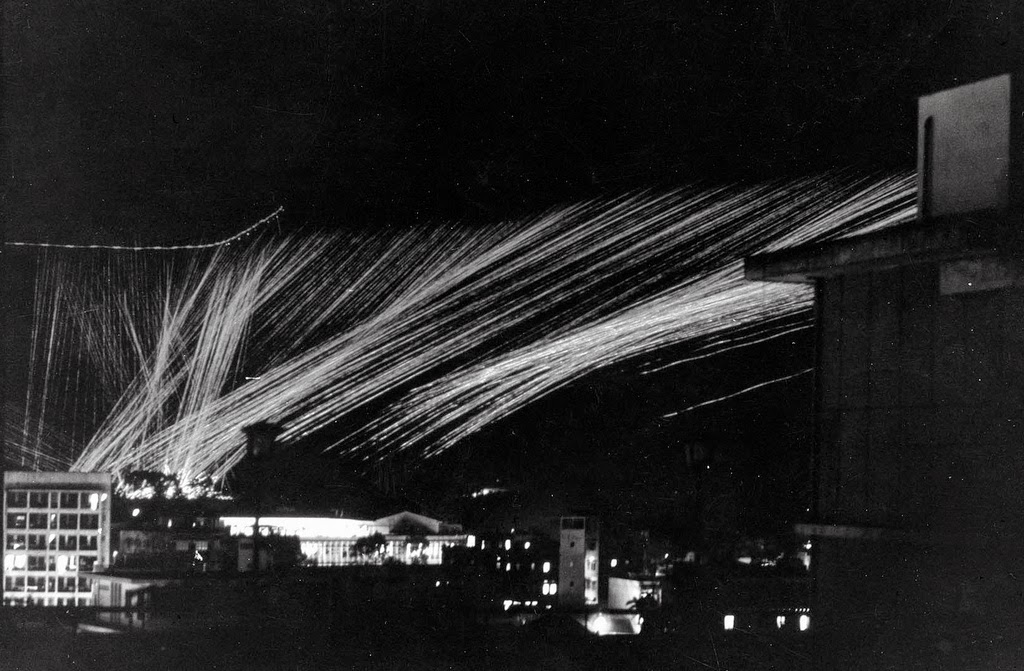

Gunships pouring fire onto the enemy


An open shutter shows how an eliptical fly path allowed massive fire-power
 to be unleashed on a relatively small (ca 50 sq metre target)

The AC-47D gunship should not be confused with a small number of C-47s which were fitted with electronic equipment in the 1950s. Prior to 1962, these aircraft were designated AC-47D. When a new designation system was adopted in 1962, these became EC-47Ds. The original gunships had been designated FC-47D by the United States Air Force, but with protests from fighter pilots, this designation was changed to AC-47D during 1965. Of the 53 aircraft converted to AC-47 configuration, 41 served in Vietnam and 19 were lost to all causes, 12 in combat. Combat reports indicate that no village or hamlet under Spooky Squadron protection was ever lost, and a plethora of reports from civilians and military personnel were made about AC-47s coming to the rescue and saving their lives.


As the United States began Project Gunship II and Project Gunship III, many of the remaining AC-47Ds were transferred to the Vietnam Air Force, the Royal Lao Air Force, and to Cambodia, after Prince Sihanouk was deposed in a coup by General Lon Nol.

A1C John L. Levitow, an AC-47 loadmaster with the 3rd SOS, received the Medal of Honor for saving his aircraft, Spooky 71, from destruction on 24 February 1969 during a fire support mission at Long Binh. The aircraft was struck by an 82-mm mortar round that inflicted 3,500 shrapnel holes, wounding Levitow 40 times, but he used his body to jettison an armed magnesium flare, which ignited shortly after Levitow ejected it from the aircraft, allowing the AC-47 to return to base.

Demand for the Spooky was so high that availability of Miniguns became a problem, so four of the AC-47Ds were put together using a stockpile of old Browning 7.62 millimeter (0.30 caliber) machine guns found in a warehouse in California, with each aircraft carrying ten side-firing machine guns each.

About 47 AC-47Ds were produced, with 12 lost in combat, particularly as enemy air defenses improved. A more capable platform -- in particular equipped with sophisticated sensor system to permit it to perform "search and destroy" missions instead of simply performing fire support -- was obviously needed. The AC-47Ds were replaced by the Fairchild AC-119G Boxcar gunship, with an electronic sensor system, for fire support missions, with the search and destroy mission farmed out to the highly sophisticated and completely fearsome Lockheed AC-130A Hercules / Spectre gunship.

Other air forces
In 2006, Colombia started operating retrofitted AC-47s, where they are known by civilians as Avion Fantasma (ghost plane). They are successfully operated by the Colombian Air Force in counter-insurgency operations in conjunction with AH-60 Arpia helicopters (an armed variant of the UH-60) and Cessna A-37 Dragonflys against local illegally armed groups. These are five Basler BT-67s purchased by Colombia with .50 cal (12.7 mm) GAU-19/A machine guns slaved to a forward looking infrared (or FLIR) system. They also have the ability to carry bombs. At least one has been seen fitted with one GAU-19/A and a 20 mm cannon, most likely a French made M621. The BT-67 is a variant of the C-47/DC-3 modified by the Basler Corporation of Oshkosh, Wisconsin.


In 1970, the Indonesian Air Force converted a former civilian DC-3. The converted aircraft was armed with three .50 cal machine guns. During 1975, the Indonesian Air Force used its "AC-47" in the Indonesian invasion of East Timor to attack the city of Dili. Later, the aircraft was used in Indonesian military close air support missions in East Timor. A retirement date is unknown.

In December 1984 and January 1985, the United States supplied two AC-47D gunships to the El Salvador Air Force and trained aircrews to operate the system. The AC-47 gunship carried three .50 cal machine guns and could loiter and provide heavy firepower for army operations. As the FAS had long operated C-47s, it was easy for the United States to train pilots and crew to operate the aircraft as a weapons platform. By all accounts, the AC-47 soon became probably the most effective weapon in the FAS arsenal.

Variants of the AC-47 based on various iterations of the airframe including the BT-67, have been used by Laos, Cambodia, South Africa, El Salvador, and Rhodesia, to name just a few, and with a variety of weapons configurations including Gatling guns of numerous types, various medium and heavy machine guns, and larger auto cannon (South African "Dragon Daks" were known to fit 20 mm cannons). The Republic of China Air Force (Taiwanese Air Force) also converted some of its C-47s to gunships. These machines were armed with M2 machine guns.


.50 cal vs 20 mm rounds for comparison


South African Air Force "Dragon Daks"


The Dak was often used for Paratroop drops


SAAF Gunships mounted either 20mm cannon or HMGs


Different arrangements were tested:
 John Vorster, later Prime Minister, inspecting a twin  HMG system


The single 20mm gun


SA Dragon Dak Gunner in action

Wednesday, 14 May 2014

Douglas C-47 Dakotas (Skytrains) in action Part 2: The History

The Douglas C-47 Skytrain or Dakota  (Part 2)

The Dakota (RAF designation) is a military transport aircraft developed from the civilian Douglas DC-3 airliner. It was used extensively by the Allies during World War II and remained in front line service with various military operators through the 1950s, and into the 1980 and early 1990s in South Africa.


During World War II, the armed forces of many countries used the C-47 and modified DC-3s for the transport of troops, cargo, and the wounded. The U.S. Naval designation was R4D. More than 10,000 aircraft were produced in Long Beach and Santa Monica, California and Oklahoma City, Oklahoma. The Oklahoma City plant produced 5,354 C-47s from March 1943 until August 1945.


Operational history

The C-47 was vital to the success of many Allied campaigns, in particular those of D-Day, Guadalcanal and in the jungles of New Guinea and Burma, where the C-47 (and its naval version, the R4D) made it possible for Allied troops to counter the mobility of the light-traveling Japanese army. Additionally, C-47s were used to airlift supplies to the embattled American forces during the Battle of Bastogne. Possibly its most influential role in military aviation, however, was flying "The Hump" from India into China. The expertise gained flying "The Hump" was later be used in the Berlin Airlift, in which the C-47 played a major role, until the aircraft were replaced by Douglas C-54 Skymasters.

In Europe, the C-47 and a specialized paratroop variant, the C-53 Skytrooper, were used in vast numbers in the later stages of the war, particularly to tow gliders and drop paratroops. In the Pacific, with careful use of the island landing strips of the Pacific Ocean, C-47s were even used for ferrying soldiers serving in the Pacific theater back to the United States.


C-47s (about 2,000 received under lend-lease) in British and Commonwealth service took the name Dakota, from the acronym "DACoTA" for Douglas Aircraft Company Transport Aircraft. The C-47 also earned the informal nickname 'Gooney Bird' in the European theater of operations.

Other sources (C-47/R4D Skytrain units of the Pacific and CBI, David Isby, Osprey Combat Aircraft #66, Osprey Publishing Limited, 2007) attribute this name to the first plane, a USMC R2D - the military version of the DC-2 - being the first plane to land on Midway Island, previously home to the native long-winged albatross known as the gooney bird, which was native to Midway.


The Luftwaffe  operated captured  DC2/3s and C47s. The one pictured above is variously described as a DC2 and 3 by various onloine sources. Apparently the personal aircraft of the German Heer  C-in-C in the Netherlands. Will research and do a separate posting! An interesting direction to explore. The Russians also License-built their own variant (more of that later too)

The United States Air Force's Strategic Air Command had Skytrains in service from 1946 through 1967.

With all of the aircraft and pilots having been part of the Indian Air Force prior to independence, both the Indian Air Force and Pakistan Air Force used C-47s to transport supplies to their soldiers fighting in the Indo-Pakistan War of 1947.

Several C-47 variations were used in the Vietnam War by the United States Air Force, including three advanced electronic warfare variations, which sometimes were called "Electric Gooneys" designated EC-47N, EC-47P, or EC-47Qs depending on the engine used.[ EC-47s were also operated by the Vietnamese, Laotian, and Cambodian Air Forces.  A gunship variation, using three 7.62 mm miniguns, designated AC-47 "Spooky" often nicknamed "Puff the Magic Dragon" also was deployed.

The Royal Canadian Air Force and later, the Canadian Armed Forces employed the C-47 for transportation, navigation, and radar training, as well as for search and rescue operations from the 1940s to the 1980s.

After World War II, thousands of surplus C-47s were converted to civil airline use, some remaining in operation in 2012, as well as being used as private aircraft.


See Part 3 of my blog for South African Air Force Dakota History (will post it tomorrow)

Large numbers of DC-3s and surplus C-47s were in commercial use in the United States in the 1940s. In response to proposed changes to the airworthiness requirements that would limit the continuing use of the large numbers of DC-3s and surplus C-47s in commercial use in the United States, Douglas offered a late 1940s DC-3 conversion. This was modified to improve takeoff and single-engined performance, to meet the new Civil Air Regulations. The new model, the DC-3S or "Super DC-3", was 39 in (0.99 m) longer. It allowed 30 passengers to be carried, with increased speed to compete with newer airliners. The rearward shift in the center of gravity led to larger tail surfaces and new outer, swept-back wings. More powerful engines were installed along with shorter, jet ejection-type exhaust stacks. These were either 1,475 hp (1,100 kW) Wright R-1820 Cyclones or 1,450 hp (1,081 kW) Pratt & Whitney R-2000s in larger engine nacelles. Minor changes included wheel well doors, a partially retractable tailwheel, flush rivets, and low drag antenna. These all contributed to an increased top speed of 250 mph (400 km/h). With greater than 75% of the original DC-3/C-47 configuration changed, the modified design was virtually a new aircraft.The first DC-3S made its maiden flight on 23 June 1949.

The changes fully met the new FAR 4B airworthiness requirements, with significantly improved performance. However, little interest was expressed by commercial operators in the DC-3S. It was too expensive for the smaller operators which were its main target: only three were sold to Capital Airlines. The U.S. Navy and U.S. Marine Corps had 100 of its R4D aircraft modified to Super DC-3 standards as the R4D-8, later redesignated C-117D.[10]

Variants:
C-47
Initial military version of the DC-3 with seats for 27 troops, 965 built
 including 12 to the United States Navy as R4D-1; C-47A; C-47 with a 24-volt electrical system, 5,254 built including USN aircraft designated R4D-5;
RC-47A: C-47A equipped for photographic reconnaissance and ELINT missions
SC-47A: C-47A equipped for Search Air Rescue; redesignated HC-47A in 1962
VC-47A: C-47A equipped for VIP transport role
C-47B:; Powered by R-1830-90 engines with superchargers and extra fuel capacity to cover the China-Burma-India routes, 3,364 built
VC-47B: C-47B equipped for VIP transport role

File:DC-3 on Floats N130Q.JPG

XC-47C: C-47 tested with Edo Model 78 floats for possible use as a seaplane

C-47D: C-47B with superchargers removed after the war
AC-47D: Gunship aircraft with three side-firing .30 in (7.62 mm) Mini-gun machine guns
EC-47D:  C-47D with equipment for the Electronics Calibration, of which 26 were so converted by Hayes in 1953; prior to 1962 was designated AC-47D
NC-47D:  C-47D modified for test roles
RC-47D:  C-47D equipped for photographic reconnaissance and ELINT missions
SC-47D:  C-47D equipped for Search Air Rescue; redesignated HC-47D in 1962
VC-47D:  C-47D equipped for VIP transport role
C-47E : Modified cargo variant with space for 27–28 passengers or 18–24 litters
C-47F:  YC-129 redesignated, Super DC-3 prototype for evaluation by USAF later passed to USN as XR4D-8
C-47L/M:  C-47H/Js equipped for the support of American Legation United States Naval Attache (ALUSNA) and Military Assistance Advisory Group (MAAG) missions
EC-47N/P/: C-47A and D aircraft modified for ELINT/ARDF mission, N and P differ in radio bands covered, while Q replaces analog equipment found on the N and P with a digital suite, redesigned antenna equipment and uprated engines
C-47R: One C-47M modified for high altitude work, specifically for missions in Ecuador
C-47T:  Designation applied to aircraft modified to a Basler BT-67 standard


C-47TP: Turbo Dakota; Refit with modern turboprop engines and fuselage stretch for the South African Air Force

C-53 Skytrooper: Troop transport version of the C-47
XC-53A Skytrooper: One aircraft with full-span slotted flaps and hot-air leading edge deicing
C-53B Skytrooper: Winterised version of C-53 with extra fuel capacity and separate navigator's station, eight built
C-53C Skytrooper: C-53 with larger port-side door, 17 built
C-53D Skytrooper; C-53C with 24V DC electrical system, 159 built
C-117A Skytrooper: C-47B with 24-seat airline-type interior for staff transport use, 16 built
VC-117A: Three redesignated C-117s used in the VIP role
SC-117A: One C-117C converted for air-sea rescue
C-117B/VC-117B: High-altitude superchargers removed, one built and conversions from C-117As all later VC-117B
C-117D: USN/USMC R4D-8 redesignated
LC-117D: USN/USMC R4D-8L redesignated
TC-117D: USN/USMC R4D-8T redesignated
VC-117D: USN R4D-8Z redesignated
YC-129: Super DC-3 prototype for evaluation by USAF redesignated C-47F and later passed to USN as XR4D-8. Wright R-1820 engines uprated to 1425 hp.
CC-129: Canadian Forces designation for the C-47 (post-1970)
XCG-17: One C-47 tested as a 40-seat troop glider with engines removed and faired over
R4D-1 Skytrain: USN/USMC version of the C-47
R4D-3: Twenty C-53Cs transferred to USN
R4D-5: C-47A variant 24-volt electrical system replacing the 12-volt of the C-47; redesignated C-47H in 1962, 238 transferred from USAF
R4D-5L: R4D-5 for use in Antarctica. Redesignated LC-47H in 1962. Photos of this type show the removal of underslung engine oil coolers typical of the R-1830 engine installation; apparently not needed in the cold polar regions.
R4D-5Q: R4D-5 for use as special ECM trainer. Redesignated EC-47H in 1962
R4D-5R: R4D-5 for use as a personnel transport for 21 passengers and as a trainer aircraft; redesignated TC-47H in 1962
R4D-5S: R4D-5 for use as a special ASW trainer; redesignated SC-47H in 1962
R4D-5Z: R4D-5 for use as a VIP transport; redesignated VC-47H in 1962
R4D-6: 157 C-47Bs transferred to USN; redesignated C-47J in 1962

R4D-6L, Q, R, S, and Z: Variants as the R4D-5 series; redesignated LC-47J, EC-47J, TC-47J, SC-47J, and VC-47J respectively in 1962
R4D-7: 44 TC-47Bs transferred from USAF for use as a navigational trainer; redesignated TC-47K in 1962

File:1 free nz photo dc-3.jpg

United States Navy R4D-8
R4D-8: R4D-5 and R4D-6 remanufactured aircraft with stretched fuselage, Wright R-1820 engines, fitted with modified wings and redesigned tail surfaces; redesignated C-117D in 1962
R4D-8L: R4D-8 converted for Antarctic use, redesignated LC-117D in 1962
R4D-8T: R4D-8 converted as crew trainers, redesignated TC-117D in 1962
R4D-8Z: R4D-8 converted as a staff transport, redesignated VC-117D in 1962

RAF designation for the C-47 and R4D-1
Dakota II: RAF designation for nine C-53 Skytroopers received under the lend lease scheme. Unlike the majority of RAF Dakotas, these aircraft were therefore dedicated troop transports, lacking the wide cargo doors and reinforced floor of the C-47.
Dakota III: RAF designation for the C-47A.
Dakota IV:RAF designation for the C-47B.
Airspeed AS.61: British conversion of Dakota I aircraft
Airspeed AS.62: British conversion of Dakota II aircraft
Airspeed AS.63: British conversion of Dakota III aircraft

Stats:
Crew: four (Pilot, Co-Pilot, Navigator, Radio Operator)
Capacity: 28 troops
Payload: 6,000 lb (2,700 kg)
Length: 63 ft 9 in (19.43 m)
Wingspan: 95 ft 6 in (29.41 m)
Height: 17 ft 0 in (5.18 m)
Wing area: 987 ft² (91.70 m²)

Dakota wrecks turn up in unusual places:

Siberia

Under water
Empty weight: 18,135 lb (8,226 kg)
Loaded weight: 26,000 lb (11,793 kg)
Max. takeoff weight: 31,000 lb (14,061 kg)
Powerplant: 2 × Pratt & Whitney R-1830-90C Twin Wasp 14-cylinder radial engines, 1,200 hp (895 kW) each

Performance

Maximum speed: 224 mph (195 kn, 360 km/h) at 10,000 ft (3,050 m)
Cruise speed: 160 mph (139 kn, 257 km/h)
Range: 1,600 mi (1,391 nmi, 2,575 km)
Ferry range: 3,600 mi (3,130 nmi, 5,795 km)
Service ceiling: 26,400 ft (8,045 m)
Climb to 10,000 ft (3,050 m): 9.5 min

Amelia Earhart's sad demise

Dozens heard Amelia Earhart's final, chilling pleas for help, researchers say Distilled from 2 posts in the  Washington Post a...