Showing posts with label A380. Show all posts

Thursday, 20 February 2014

Circumnavigation of the globe: My Airline Opinions

I have just returned from an around the worlds trip with my family. Our trip gave us reason to fly in many aircraft, including the 100th Airbus A380:


We experienced several airlines, and varying standards of service and in-flight food, and in-flight entertainment.


The main carriers we flew with were Air Malaysia and Air Tahiti Nui


We also flew regionally with Air Asia and Aer Lingus, and of course Air New Zealand
As budget and regional airlines these can not be faulted. Professional and friendly service, of course no trimmings, but who needs that on a 60 minute flight? Good pilot skills and well maintained, new aircraft.

Local flights were all on Airbus variants, mostly the 320 range, while the Air Tahiti Nui flight from LA to Tahiti was on a A340-400. The Air NZ flight was a Bombardier from Paraparaumu to Auckland

So International Airlines first: Tahiti Nui
(LAX to Papa'eete, Tahiti)

The Rangiroa, the A340-300: F-OSEA was a great aircraft with up to date passenger comforts and technology. Service was on "Island time", and though friendly and hospitable, pales when measured against airlines such as Air NZ, South African Airways, BA, Lufthansa or Qantas.

Noticeable was a paucity of drinks rounds. Drinks were only served with the meal, no separate pre-dinner drinks, no offers for more drinks, only a water round halfway through the flight. The food was good, French in origin, but on both Tahiti Nui flights the bread rolls were not heated, and appeared decidedly stale.

Other than this I could not fault Tahiti Nui. A nice touch was the distribution of frangipani flowers after take-off at LAX. (A nice island touch, which sets the scene for a tropical holiday experience. I suspect this may have replaced the initial drinks round though, and I would rather have had a beer ! Going through US customs and immigration is thirsty work. )


Flying back to NZ was another story. Think the oldest aircraft in their fleet, in-flight entertainment not working, not for anyone. Stafff shrug, sorry, it doesn't work. 9 hours of BOREDOM. This crew a bit more forthcoming with drinks, but you had to ask. Again the drinks round was absent and the cold, STALE BUNS! For goodness sake Tahiti Nui! Get your act together! 
Everyone in Tahiti eats fresh Baguette! What is up here? 
Landed safely enough, but I doubt I'd easily fly Tahiti Nui again. I think better value can be had from other airlines for the same price.

Air Malaysia can not be faulted, great service, great food- probably some of the best inflight meals I ever had was on board the A380 - On the way to London ex KL the Chicken Biryani, was as good as you'd get in a restaurant. Well done.

Kids under 12 were allowed on a behind-the-scenes tour of the aircraft. 
No amount of trying to convince the cabin crew that I was 12 would work. 
(Think the moustache and "traveller's beard" the kids had convinced me to grow was a dead give-away!)



Friday, 14 June 2013

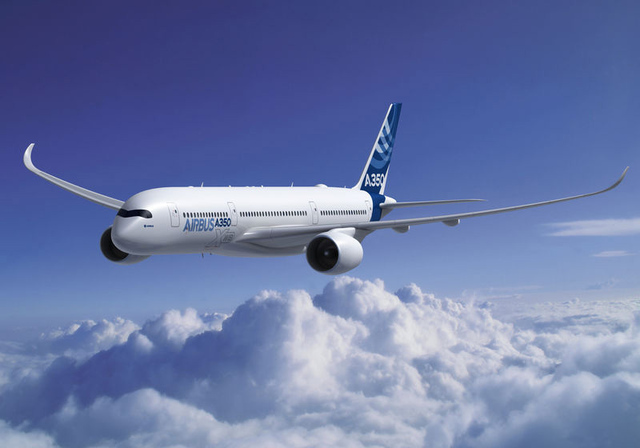
Airbus A350 Takes to the skies

Airbus A350 First Flight


(Reuters) - After the Dreamliner, the Hushliner?

Europe's latest extra wide-body passenger jet, the Airbus A350, made its maiden flight on Friday and its chief salesman, opening a new front in a battle with U.S. rival Boeing declared it so quiet that airport residents won't even notice it.

The lightweight carbon-plastic jet flew over the Airbus plant in Toulouse to salute production workers before wrapping up a four-hour inaugural flight that Airbus officials said had achieved more than expected.


Watched by 10,000 staff and spectators, the aircraft's curled wingtips sliced into clouds above the factory in southwestern France and flew over the Pyrenees.

The sortie caps eight years of designing and development costing an estimated $15 billion.

Airbus's ebullient New York-born sales chief, John Leahy, lost no time in talking up the plane's benefits moments after its two Roll-Royce (RR.L) engines hoisted the A350 from the same runway where the supersonic Concorde took its first ground-shaking run 44 years ago.

"Did you hear how quiet it was? We are going to set new standards ... People round airports won't even know we are taking off," Leahy said.

It is a milestone for the EADS (EAD.PA) unit as it seeks to catch Boeing's 787 Dreamliner in sales of a generation of lightweight jets designed to save fuel and do less harm to the environment.

Boeing was first off the mark with the use of revolutionary carbon-composite materials and its Dreamliner has so far outsold the A350, with sales reaching 833 aircraft to 57 customers.

With sales of 613 planes to 33 customers, Airbus hopes to catch up and also mount a challenge to the U.S. manufacturer's larger, metallic 777, thanks in part to the A350's low noise.

"READY TO FLY"

British test pilot Peter Chandler, who commanded a crew of six pilots and test engineers wearing helmets and parachutes over orange jumpsuits, was elated about the plane.

"It was ready to fly and it wanted to fly. It was clearly much happier in the air," Chandler said.

French co-pilot Guy Magrin, a former air force pilot, took the controls for the take-off at 10:01 local time


Competition for wide-bodied jets is expected to dominate next week's Paris Airshow, where the A350 has its sights on another fly-by when French President Francois Hollande visits the event on Friday, if tests continue to go well.

"I am talking to airlines about placing orders in the very new future. I think you may see some announcements very soon," sales chief Leahy told Reuters.

Airbus is finalizing orders from Singapore Airlines  , Kuwait Airways and Air France  and hopes to add a new customer at the June 17-23 show, analysts say.

Boeing sees a market worth $1 trillion for one category of mid-sized long-haul passenger airplanes over the next 20 years and the A350 and 787 are chasing the lion's share of that.

More expensive than other aircraft at about $300 million apiece at list prices, the A350's business case relies on fuel savings of some 25 percent compared with ordinary airliners.

But aerospace manufacturers are also under pressure to cut emissions and noise to comply with tougher global regulations.

EDGE ON NOISE

Airbus and Boeing both claim the edge on noise levels, which remain politically explosive at airports like London's Heathrow.

Airbus said the A350 is up to 16 decibels below international requirements. Boeing said its 787 has a smaller noise footprint than other widebody aircraft, and is equivalent to the sounds of heavy traffic when standing at a roadside.

"We welcome any moves towards quieter planes, but let's not run away with the idea that the A350 is a quiet plane. It is simply less noisy than its predecessors," said John Stewart, chair of a residents' group opposing the expansion of Heathrow.

The A350's maiden flight is the start of a 12 to 13 month test program that will include putting it through the harshest possible conditions around the globe.

Airbus says it is on track to put the aircraft into service with Qatar Airways in the second half of 2014, but the timetable remains "challenging".


Project leader Didier Evrard, a former missiles boss credited with preventing a repeat of the disarray on recent Airbus programs, has a major job to produce four more test aircraft and could not relax during the flight.

"I will still be nervous until it comes back. I'm an engineer so I have to be connected to the ground and make sure everything is fine," he told reporters.

Evrard said Airbus would soon add a customer in the United States, where industry sources say United Airlines is negotiating to expand an order for 25 jets.

Airbus initially dismissed new mid-sized aircraft like the 787 as it focused on building the world's largest airliner, the A380 superjumbo, in the last decade.


But faced with burgeoning Dreamliner sales, it changed tack and overhauled the design of the 270- to 350-seat A350 by adopting similar composites technology in 2006.


To boost sales, Boeing is expected to soon confirm plans to build a larger version of its Dreamliner. It is also overhauling its 777 with new engines and wings.

Wednesday, 12 June 2013

Clip-on train: Voila! Regardez: A plane ! The Clip-Air project

The Clip-on Train becomes a plane
The Clip-Air project envisions an airplane consisting of a single flying wing onto which capsules carrying passengers or freight can be attached. More than a new type of flying device, its innovative concept could revolutionize the airports of the future.
Check this Out:

Click on link for video
Go to the train station to take the plane. Board on a capsule to reach the airport by rail, and then - without leaving your seat - fly to another city. The Clip-Air project, being developed at EPFL since 2009, envisions a modular aircraft consisting of a flying wing onto which it is possible to attach one, two or three capsules as required. Its concept allows us to take a glimpse at the air transportation of tomorrow, which is meant to be more flexible, closer to our needs, more efficient and less energy-consuming. For the first time, a model of the Clip-Air plane will be presented at the Paris Air Show from 17 to 19 June 2013.
Despite its being a very futuristic project, the scientists behind it work under rigorous constraints to maintain its technical feasibility. "We still have to break down several barriers but we do believe that it is worth to work in such a concept, at odds with current aircraft technology and which can have a huge impact on society," said Claudio Leonardi, in charge of the Clip-Air project.
The Clip-Air project’s main contribution would be to provide rail transport’s flexibility to air transport. On the one hand, the Clip-Air plane includes a support structure made up by the wing, engines, cockpit, fuel and landing gear. On the other hand, there is the load to be carried: passengers and/or freight. Hence, the capsule would be equivalent to a real airplane’s fuselage, but without its usual attributes. The flying wing can accommodate up to three capsules with a capacity of 150 passengers each.
New generation fuel
Theoretical studies show Clip-Air’s potential in terms of transportation capacity thanks to a more efficient and flexible fleet management, a more efficient loading rate, increased flexibility of supply and the possibility of no more empty flights. Further advantages would come from savings in maintenance, storage and management.
Clip-Air also aims to address current environmental concerns as wells as the objectives set by the ACARE (Advisory Council for Aeronautics Research in Europe) to reduce by 50% CO2 emissions by the year 2020. Clip-Air aircrafts’ conventional fuel consumption would be reduced since they can carry as many passengers as three A320 with half the engines. In other words, flying with three modules under the same wing in a 4000 km flight would be cheaper - in terms of fuel consumption - than three aircrafts of the same capacity flying independently and with equal speed and altitude.
Then again, Clip-Air’s ambition also envisages other types of fuels, less polluting than the ones currently consumed. Several possibilities (liquid hydrogen, biofuels and conventional fuel) have been studied and have demonstrated the relevance of modular structures in terms of overall consumption.
A revolution in mobility
A Clip-Air aircraft could fit in an airport as it is conceived today. With its autonomous capsule, the size of a railroad car - about 30 meters long and 30 tons heavy - its design is compatible with rail tracks. Therefore, it could eventually revolutionize airport configuration and multimodal mobility. The boarding of either cargo or passengers in the capsule could be done not only at airports but also directly in rail stations or production sites.
In technical terms, initial studies have shown that the project is feasible, even though there are still many challenges ahead. “The development of the concept requires performing more advanced aerodynamic simulations and testing a 6 meters long flying model powered by mini-reactors in order to continue to explore the concept’s flight performance and to demonstrate its overall feasibility”, added Claudio Leonardi.
For now, a 1.20 meters long model of the Clip-Air plane will be presented at the Normandy Aerospace stand at the Paris Air Show, from 17 to 19 June 2013. At the moment the project involves researchers from three EPFL laboratories (TRANSP-OR, LIV and ICOM). It is coordinated by EPFL’s Transportation Center.

Source EPFL's site

Amelia Earhart's sad demise

Dozens heard Amelia Earhart's final, chilling pleas for help, researchers say Distilled from 2 posts in the  Washington Post a...